By Chris Chavez
April 24, 2026
By Chris Chavez & Preet Majithia
The 2026 London Marathon might just feature the greatest field ever assembled… that is, until next year. The race’s organizers outdoing themselves with increasingly star-studded entry lists is something of an annual tradition. But let’s not get ahead of ourselves, because what’s on deck for this weekend is going to be truly special. The race takes over the streets of the British capital on Sunday, April 26th, with what may be the deepest pro races in the race’s 45-year history.
We jumped on the mics on Wednesday afternoon to discuss both races at length. You can listen to the full preview on The CITIUS MAG Podcast. Available on Apple Podcasts, Spotify or wherever you get your shows. We’ll also have it up on YouTube later today.
You’ll be able to watch the race with a Flotrack subscription ($29.99 per month for a month or $149.99 per year). Preet Majithia will be on-site for the CITIUS MAG team providing live updates from the media tent on the CITIUS MAG Twitter page and interviews with the athletes afterward on the CITIUS MAG YouTube channel.
Start times:
- Elite women: 9:05 a.m. (BST) → 4:05 a.m. (EDT)
- Elite men + first mass wave: 9:35 a.m. (BST) → 4:35 a.m. (EDT)
Women’s Race
The Favorites: Tigst Assefa (2:11:53 PB from Berlin 2023) | Joyciline Jepkosgei (2:14:00 PB from Valencia 2025) | Hellen Obiri (2:17:41 PB from Boston 2025)
When the fields were first announced, it was originally billed as the first marathon in history to feature four women with sub-2:15 personal bests. That storyline is out the window after withdrawals by Olympic champion Sifan Hassan and World champion Peres Jepchirchir due to injury. But it also means the race may be more tactically open between the top three women who remain.
Assefa enters as the defending champion and a former outright world record holder, coming off a strong 2025 that included the women’s-only marathon world record (2:15:50) in London and a silver medal at the World Championships. In each of her last six marathons, she has finished in the top two and the only two women to beat her in the last four years are now both out of the race.
Jepkosgei was the runner-up here last year and then went to Valencia in December to win in a world-leading 2:14:00, beating Jepchirchir in the process. She’s also a past champion here having won in 2021 and finishing on the podium three times after that.
And Obiri is… well… Obiri. Her last two races were both in New York City, last November’s marathon, and last month’s half—she won them both in course record fashion. Obiri’s marathon PB looks paltry compared to Assefa’s or Jepkosgei’s, but there’s no denying her ability to grind it out over the hills of New York City, Boston, or at the Paris Olympics. This will be her first World Major outside of the U.S., and first attempt at the distance on a traditionally fast course.
Preet Majithia: “Last year the race went out in 1:06:40 for the first half and came back in around 1:09, so it was a positive split. London is slightly faster in the first half; it’s slightly downhill, which is why you often expect a slightly positive split. What was interesting was that Tigst Assefa said she is in better shape than she was last year. When I asked specifically whether she thought she could run better by going out a little slower, she said, actually, no—she thinks she’s fitter than she was last year and can handle the pace. She said that when the pacemakers drop out around halfway, she thinks she’s fit enough to carry that 1:06:40 tempo on her own. She sounds like she’s definitely gunning for it. And it was very clear that both she and Joyciline Jepkosgei have sub-2:15 as the goal.”
Obiri is the most fascinating athlete in the race. She has never run a marathon with pacers, never run a flat course, and her PB was set over Boston’s point-to-point, hilly layout. Her two New York wins tell you she’s a ferocious competitor, but they tell you almost nothing about her ceiling on a course like this. Coach Dathan Ritzenhein said she was capable of running 2:11 as early as two years ago. Even 2:14 or 2:15 this weekend would be a massive performance and put her squarely in the conversation of being the world’s best marathoner.
Preet Majithia: “Hellen said very clearly: ‘I’ve never run a race like this before — not with pacemakers, not on a flat course. I’m going to sit in behind the leaders and wait to see how I’m feeling around the 30 or 35K mark.’ It sounds like everyone is expecting those three to be in the same pace group.”
Head-to-head, Assefa is 2-0 against Jepkosgei (at the last two Londons) and 1-0 against Obiri (at the 2024 Olympics). Obiri is 1-0 against Jepkosgei in Boston 2023, but given their relative lack of direct matchups, it’ll be fascinating to see how the three key off of each other in the same race.
Compared to other World Marathon Majors, the prize money in London is not terribly high—first place wins $55,000. Time bonuses are where the real money is earned in London. In the pre-race press conference, organizers have stated that the lead pack will be after the women’s-only marathon world record. If someone runs under 2:15, the athlete gets $150,000. Sub-2:15:30 nets $100,000. Sub-2:16 receives $75,000.
Paula Radcliffe’s course record is 2:15:25, which has stood since 2003. (That’s not the women’s-only world record because, at the time, it wasn’t run as a women’s-only race.) If you win and break the women’s course record, you get an additional $25,000.
Chris Chavez: “The big three are just such heavy favorites that the podium is [likely] some combination of Assefa, Jepkosgei, and Obiri. Even if one of them falters, like, if you’re Hellen Obiri with a 2:17 PB going out at 2:15 pace, you could have a Sifan Hassan moment by taking a little walk break — and still probably finish third, because I don’t see anyone else going with that pace.”
Beyond the Big Three, the most interesting race-within-a-race may be between three talented Brits looking to improve their spots on the U.K. all-time list. Rose Harvey, Eilish McColgan, and Jess Warner-Judd are sixth, ninth, and tenth, respectively, on said list, but particularly because the latter two spend more time on the roads than the track, it feels inevitable they’ll improve on their 2:24 PBs. Harvey, on the other hand, benefits from experience, having finished top-15 in this race in three of the last five years.
The other intriguing name on the start list is reigning World bronze medalist Julia Paternain, who represents Uruguay internationally but lived in the U.K. as a child and currently trains in the U.S. Given that her 2:27:09 PB comes from the hot championship setting of Tokyo last fall, she’s likely looking to significantly upgrade that PB to better reflect her stature as a global medalist.
Men’s Race
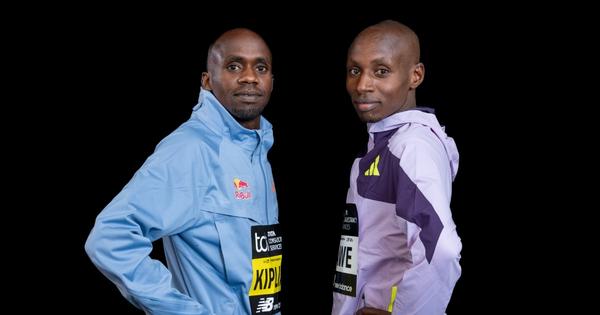
The favorites: Sabastian Sawe (2:02:05 PB from Berlin 2025); Jacob Kiplimo (2:02:23 PB from Chicago 2025)
The men’s race could be a thriller, because you’ve got so many talented guys—five sub-2:04 athletes, eight sub-2:05, plus the intriguing debut of Yomif Kejelcha.
That said, if you were designing a boxing-style poster for London ‘26, you’re giving Sebastian Sawe vs. Jacob Kiplimo top billing—a true title fight. Last year’s race wasn’t too much of a contest after Sawe dropped a 4:16 at mile 20 and ended up winning by over a minute. But the key thing to remember is that it was Kiplimo’s marathon debut. Since then, both have leveled up considerably.
Last fall, Sawe won Berlin in 2:02:16 on a really hot day. The buzz leading up to the race was that he was getting drug tested 25 times in the lead-up because he genuinely believed he could break Kelvin Kiptum’s world record of 2:00:35 and wanted to leave little doubt around the legitimacy of his performance. There is specific funding allocated in Sawe’s contract towards the Athletics Integrity Unit, with the anti-doping authority determining how best to use it. The AIU apparently determined the concentrated testing in the run-up to Berlin was worthwhile, but was very expensive, so it has not been repeated in the run-up to London. The understanding is that he is still being tested more than other athletes due to the funding being provided.
However, Sawe suffered a stress fracture after Berlin, and then had a back issue in January. These have both cleared up and his coach Claudio Berardelli said that they have not significantly hindered his preparation. In three career marathons, Sawe has never lost and never run slower than 2:03:00—that’s a pretty tough resume to beat.
Then there’s Kiplimo, who finished second in London and then won Chicago in 2:02:23, covering the final 5K in what looked like a jog. After that, he won his third straight World Cross Country title, then broke the half marathon world record, running 57:20 in Lisbon (his PB of 56:42 is still faster, but that time was not ratified as an official WR).
Kiplimo indicated he has upped his mileage for this build and is now running 200km-230km (~120-145 miles) a week, which is significantly more than last year. The gap between Sawe and Kiplimo is probably much closer than last year’s results would indicate.
Preet Majithia: “With Kiplimo, I think we’re still finding his ceiling. He’s relatively new to this. In London last year, whether it was a tactical error or just a lack of confidence to go with the move, he let it slip. But his performance in Chicago was really impressive. Sawe, on the other hand, has just hit it out of the park every time he’s run a marathon, starting with Valencia in 2:02:05 at the end of 2024, then London and Berlin last year. It’s going to be an intriguing battle, and I genuinely can’t pick one.”
Chris Chavez: “With Kiplimo in Chicago and Sawe in Berlin, both managed to get to 30K at world record pace. What happens after that point is where the race is truly going to be made.”
The Other Contenders
The other runners likely to go with Sawe and Kiplimo include Amos Kipruto (2:03:13 PB), Olympic champion Tamirat Tola (2:03:39 PB), and 10,000m World Championship silver medalist Yomif Kejelcha. Tola just won the Doha Marathon earlier this year in 2:05:40 in hot conditions, so if he’s maintained or improved on that kind of fitness, he’s a threat.
The debutant Kejelcha is more of a wild card. The stats around him are impressive: 3:47 in the mile, three-time Valencia Half Marathon champion, and former half marathon world record holder at 57:30. But all that speed skews to shorter events. Even with a very fast 5K or 10K background, the marathon is a different beast, as we saw with Joshua Cheptegei’s foray into the event, and there’s sometimes a learning curve. Some people, like Sifan Hassan, defy that and win their debut despite coming straight from the track. Kejelcha certainly has the talent to open up in 2:03. And if he’s still in contention through 35K, his closing speed could be a real factor.
Preet Majithia: “Don’t forget…Tola and Kejelcha train together as part of the same group that is coached by Gemedo Dedefo, who also coaches Tigst Assefa. One of the British athletes, Mahamed Mahamed (2:07:05 PB), has been out in Ethiopia training with Kejelcha and Tola. And from what we’ve heard, the training out there is absolutely insane. I know that’s what you always hear from people who go to Ethiopian or Kenyan training camps, but it does seem pretty intense.”
Mahamed came very close to a podium finish in 2024, finishing fourth in 2:07:05, and with no Emile Cairess in the race (2024’s third-placer), he and Phil Sesemann could leapfrog Cairess on the British all-time list with a pair of PBs. Currently, the list behind Mo Farah goes triathlete Alex Yee at #2 in 2:06:38, Cairess #3 at 2:06:45, Mahamed #4 at 2:07:05, and Sesemann #5 at 2:07:11. Surely both men—plus Patrick Dever, who ran 2:08:58 for his debut in NYC last fall—would love to knock the triathlete back a spot or two and win one for the pure road runners.
Amanal Petros had a career year in 2025, with a silver medal at the World Championships in a sprint finish, and a PB and German record of 2:04:03 for second place in Valencia behind John Korir. Coached by the Italian Renato Canova, Petros has started 2026 in a similar fashion, breaking the German record in the half marathon (59:22 in Berlin), and will likely be targeting Bashir Abdi’s European record of 2:03:36.
Joshua Cheptegei, the two-time Olympic gold medalist, has a 2:04:52 best at the moment, and maybe London, his fourth career marathon, is where it all comes together. Not everyone gets it right the first time. Sometimes it takes two or three races. It’s clear Cheptegei is fully committed to the marathon now since he skipped the World Championships last year. With more time fully dedicated to the event, perhaps we see a bit more progress from the current 5000m and 10,000m world record holder.
For more on the 2026 London Marathon, you can listen to the full episode of The CITIUS MAG Podcast or watch it on The CITIUS MAG YouTube channel.
Chris Chavez
Chris Chavez launched CITIUS MAG in 2016 as a passion project while working full-time for Sports Illustrated. He covered the 2016 Olympics in Rio de Janeiro and grew his humble blog into a multi-pronged media company. He completed all six World Marathon Majors and on Feb. 15th, 2025 finally broke five minutes for the mile.