By David Melly
January 14, 2026
As far as we know, no one got eaten.
The best cross country runners in the world survived Florida humidity, poisonous snakes, and whatever forever chemicals were in those neon-blue water pits to deliver an entertaining World Cross Country Championships to the U.S. audience for the first time in three decades. Apalachee Regional Park in Tallahassee provided a welcoming backdrop for thrills, spills, and the first global medals of 2026 as Ethiopia swept both senior team titles, holding off the defending champs from Kenya without winning either individual race.
It’s understandable to think that Jacob Kiplimo’s transition to the marathon would leave him a little vulnerable over 10km, particularly given that he won Chicago just three months ago. But if he was feeling rusty, it certainly didn’t show. The 25-year-old Ugandan won his third straight title in dominant fashion, absolutely tearing apart the final lap to leave three-time runner-up Berihu Aregawi in his dust. Kiplimo’s final 2km split through the mud, artificial hills, and turns was a ridiculous 5:22—that’s 4:19 mile pace. He put 18 seconds on Aregawi, a 12:40 5000m runner, and third-placer Daniel Ebenyo. There was only one apex predator on the course on Saturday, and it was Kiplimo.
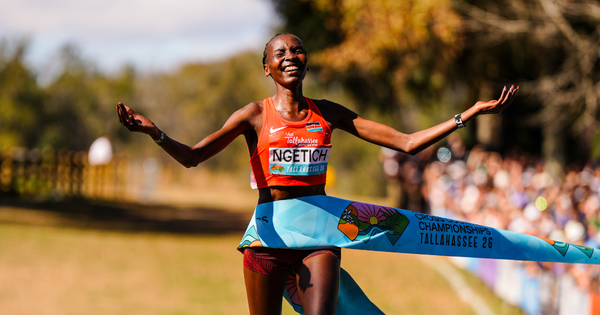
On the women’s side, Agnes Ngetich was just as lethal but with a totally different kill strategy. It was a familiar sight to anyone who followed Ngetich, the world record holder on the roads over 10km, throughout her track season last year: she hit the front and pushed the pace, daring anyone else to try and follow. No one made it even a third of the way, as second, third, and fourth placers Joy Cheptoyek, Senayet Getachew, and Asayech Ayichew were all dropped by 3km. Ngetich went on to win in 31:28, a ridiculous 42 seconds up on Cheptoyek, the Ugandan record holder over 5km and 10km. Ngetich’s hot early pace strung out the whole field, which made for a brutal final lap for many of the racers in the heat and humidity. It’s inordinately hard to compare times over different courses, but only six women broke 33 minutes in Tally, compared with 16 two years ago in Belgrade.
Speaking of struggles, it was a fairly tough day at the office for a good chunk of Team USA. In all fairness, the Americans had their work cut out for them: for both the senior men and women, a team medal was really only possible if the top four scorers had awesome days and one or more of the East African superteams faltered. Uganda has historically brought less depth than Kenya or Ethiopia, but they still managed to put five women in front of Team USA’s third. Uganda’s fourth man, Emmanuel Kibet, beat Nico Young by 15 places, a pretty brutal gap given Kiplimo’s low stick.
If Young or Rocky Hansen, who had to pull out of the race the day prior with an injury, had finished alongside U.S. XC champ Parker Wolfe, again the top American in 12th, Team USA would’ve still been 18 points off the podium. On the women’s side, U.S. champ Weini Kelati took a risk early, running near the top 10 for most of the race, but she had a pretty brutal final lap and ended up 40th, Team USA’s last finisher. Had she finished up with Ednah Kurgat, who had a great performance with a 10th-place run to lead the team, they still would’ve missed the podium by 24 places. Heck, both teams could’ve scored three runners against Kenya/Ethiopia/Uganda’s four and still missed the medals.
This isn’t to say the Americans didn’t put in a very respectable effort; it’s simply to demonstrate that there is no margin for error when the favorites bring the heavy artillery. Team USA fielded strong teams and its entrants performed mostly up to par, but even with the home field advantage, World XC is no cupcake race. It’s a brutal, punishing affair, and if there’s any takeaway home from Tallahassee, it’s that winning is really, really impressive. The general sentiment that there’s any sort of hierarchy of global medal legitimacy that places the Olympic gold at the top and everything else laddering down doesn’t hold up when you look at just how hard World XC medals are to come by, and how few runners are able to consistently win on the grass.
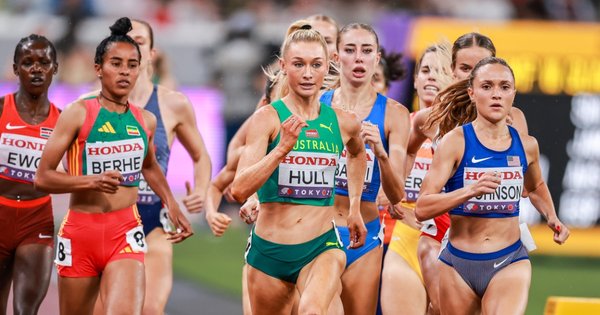
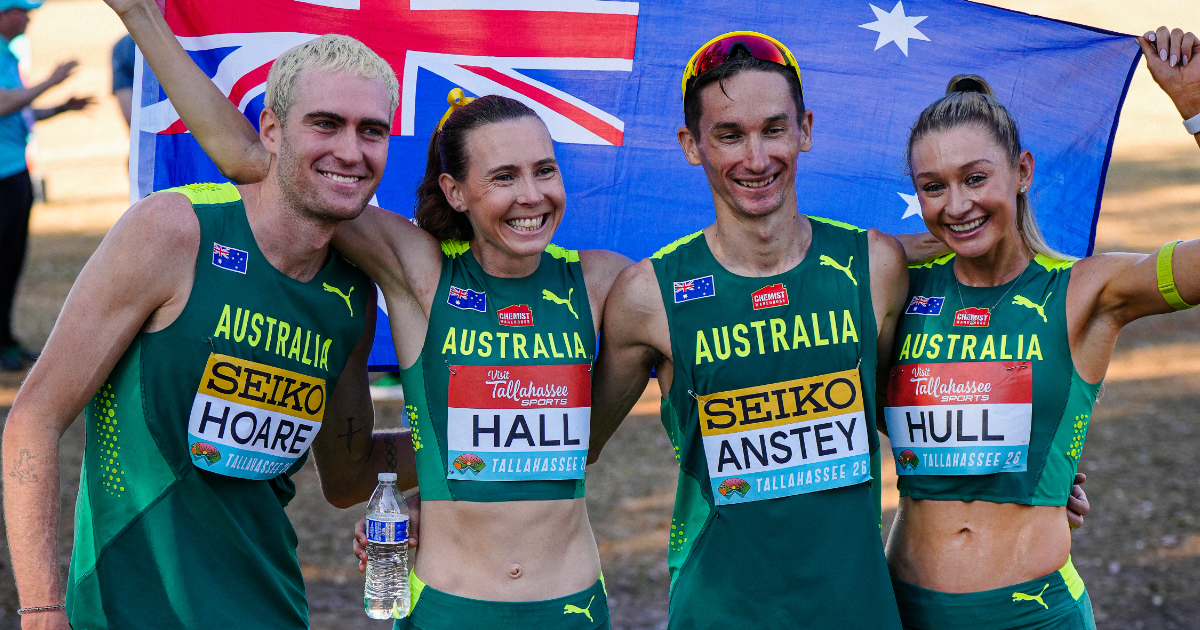
That makes Australia’s performance in the mixed 4x2km relay all the more impressive. Since the relay was added to the program, Kenya has taken three of four golds on offer and non-African teams have finished no higher than bronze. On paper, the Aussies had the most impressive team by resume, with Olympic medalist Jessica Hull, Commonwealth Games champ Olli Hoare, 3:56 woman Linden Hall, and 3:51 miler Jack Antsey tapped for the job.
Track PBs don’t necessarily translate to success when hurdling artificial alligators in Tally, but Hull was able to decisively drop French 1500m record holder Agathe Guillemot on the anchor. Just as importantly, Hull got the baton with a comfortable 11 second cushion on the defending champs from Kenya, increased that gap to 19 seconds, while Kenya fell off the pace and podium entirely.
Cross country is famously unpredictable, but in the end, one thing did seem to play out according to form: the fastest, most experienced runners came home with the hardware. One of the best strategies to bulwark against uncertainty is to be really, really good—both individually and as a team. And one of the ways to show you’re really, really good is to build a medal shelf that shows you can get the job done on any surface. By that standard, World XC both attracts and creates the sport’s all-time greats.
David Melly
Since David began contributing to CITIUS in 2018, he's done a little bit of everything, from podcast hosting to newsletter writing to race commentary. Currently, he coordinates the social media team and manages both the CITIUS MAG newsletter and The Lap Count, supplying hot takes and thoughtful analysis in both short- and long-form. Based on Boston, David breaks up his excessive screen time by training for marathons, crewing trail races, baking sweet desserts, and mixing strong cocktails.