By David Melly
October 14, 2026
For many viewers, the defining moment of the 2026 Chicago Marathon didn’t come at the finish line. It didn’t feature any of the podium finishers. And no, it didn’t come during the cutaway interviews in the final stages of the women’s race.
The visual that will endure in the minds of U.S. distance running fans came around 100 minutes into the race, where at mile 22, three Americans—Clayton Young, Charles Hicks, and Vinny Mauri—were running stride for stride, trying desperately to cling to national-record pace while also battling for top domestic honors. It was a perfect encapsulation of what makes road racing unique. The trio was working together, against the course and the elements (in this case, oppressive humidity on a warm October morning), while also looking for any opportunity to break their competition.
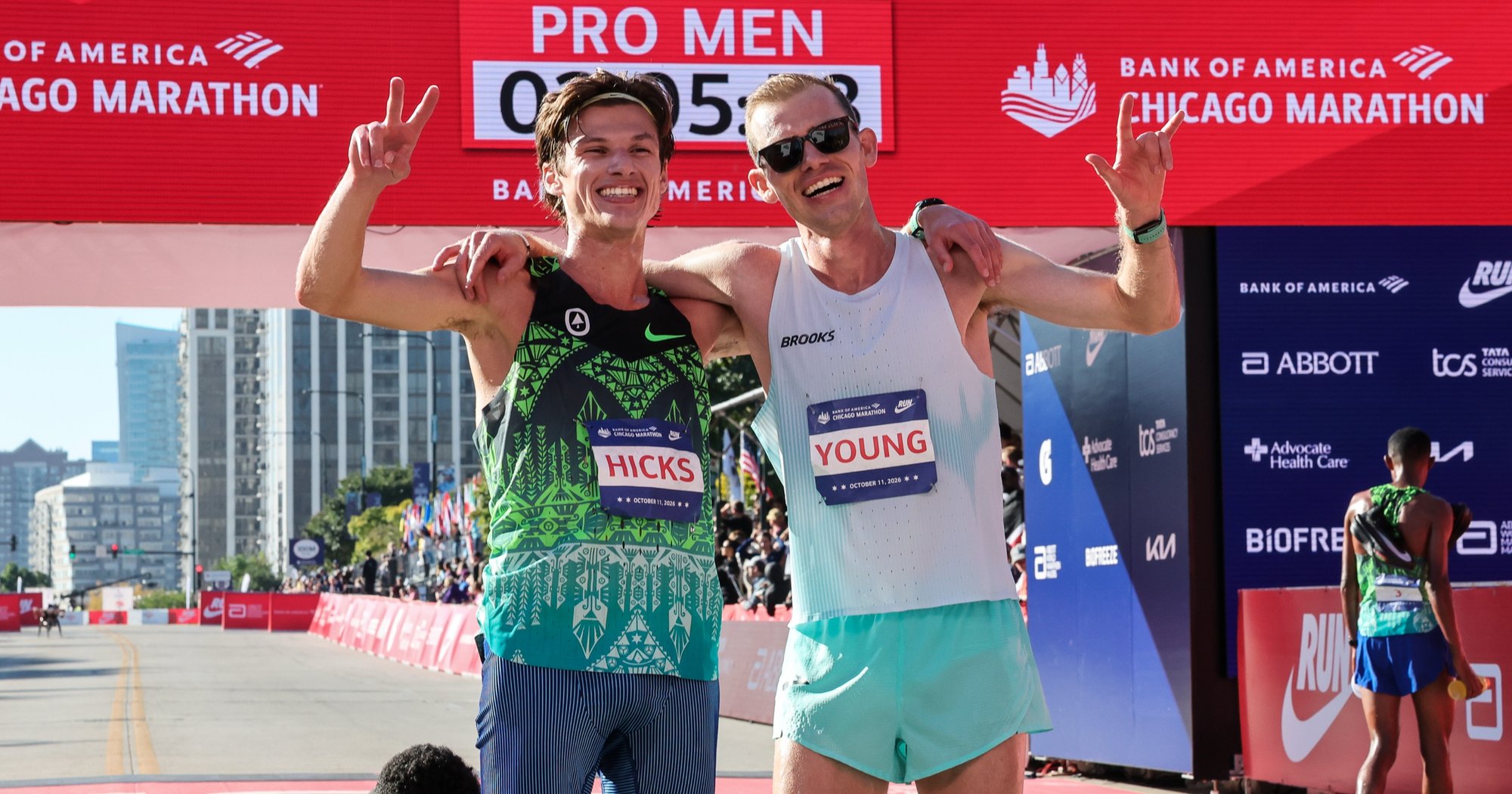
All three men slowed down to varying degrees over the final 10 kilometers, but ultimately Young and his beat-up hamstring slowed the least. The 33-year-old crossed the finish line in seventh place overall and a new personal best of 2:05:23. Despite being a picture of top-ten consistency over the last several years, it was Young’s first top-American finish at a World Marathon Major after so many races behind his training partner Conner Mantz. (He also did the statisticians a favor by bettering his Boston time from this past April to become the second-fastest American ever behind Mantz on record-eligible courses, no asterisk necessary.)
One spot behind him was Hicks, who often looked the best of the group in the waning miles but ended up 12 seconds behind Young in 2:05:35. He’s now the sixth American member of the official sub-2:06 group (ninth if you count Boston times). At 25 years old, Hicks has now completed the NYC-Boston-Chicago trifecta in his first year of marathoning in stellar form, finishing sixth, seventh, and eighth in his first three cracks at the distance.
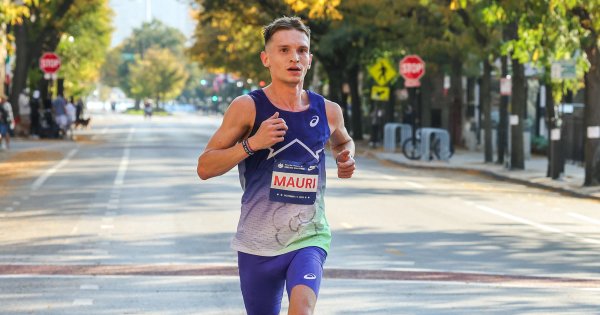
Yet he wasn’t the even least experienced top-ten finisher. Planet Fitness’s own Vinny Mauri made things really interesting halfway through the race, dropping a 14:28 5k from 20k to 25k to put himself in no man’s land and on 2:04 pace, and for about 20 miles, it looked like Mantz’s one-year-old American record was toast. Mauri’s move did eventually come back to bite him, however, as he had to stop and stretch out his hamstrings at least twice, providing a tantalizing target for Hicks, Young, and Japan’s Akira Akasaki to reel in.
Once caught, Mauri didn’t give up the fight entirely, staying at or near the front of that mini-group as long as he could. And even when he couldn’t, he didn’t crater too terribly—especially compared with fourth placer Jacob Kiplimo, whose attempt at a title defense ended with a 5:37 final mile after eventual winner Amos Kipruto broke him completely. Mauri hung on to stay in the top ten and finish under 2:07, clocking 2:06:45 for tenth—one spot ahead of Galen Rupp, who obliterated the American masters record.
Let that sink in for a moment. If you’re the skeptical type who saw Mauri’s solo debut run at the Glass City Marathon and stranger-than-fiction Strava account and thought to yourself, “this simply can’t be right,” pretend for a moment you’d never heard of Mauri before Sunday. A 25-year-old 13:34.03 5000m runner whose best career NCAA result was 18th finished top-ten in a World Major in his second marathon, running faster than Bill Rogers, Meb Keflezighi, or Dathan Ritzenhein ever did. Any one-hit wonder allegations are surely sounding pretty silly now.
What really makes that mid-race moment memorable is that it’s kinda the perfect encapsulation of the state of the U.S. marathon in 2026. Clayton Young — ironically the eldest of the group — debuted at the distance at 26, less than a year after graduating BYU (hold your jokes). Hicks too had barely let the ink dry on his Stanford diploma before signing up for his first marathon, even with an NCAA cross country title and a handful of All-American finishes on the track.
Marathoning used to be an old man’s game, the farm upstate you sent yourself away to once you’d squeezed every drop of fast twitch juice out of your legs on the European track circuit. However, American marathoning has gotten younger and younger in recent years, making the Scott Faubles and Molly Seidels of the world seem like trendsetters, not aberrations. And of course, Mauri is the strangest of all, a truly once-in-a-generation runner who cannot be categorized in any way. Yeah, he’s not the first runner ever to do crazy volume and intensity. Yeah, he’s far from the only pro marathoner who was a no-name in college. But somewhere around mile 16 of Chicago it became abundantly clear (if it wasn’t already) that this guy was special, and not just because he managed to stuff a pair of bowling balls in his half tights.
There have always been many pathways to marathoning excellence, but it seems like the variation in approach has only expanded over time, not narrowed down to a single best practice. There are Nike-branded elites mileagemaxxing under the watchful eye of Jerry Schumacher and unsponsored run-specialty salesmen asking the group chat for workout ideas, and the only time they meet up is mile 20. Part of why we as running nerds love the Olympic Marathon Trials is because it brings together 400 or so of those unique journeys to one start line, and there’s no single dominant strategy to guarantee a top-three finish.
Young, Hicks, and Mauri are about as different as three guys who all once stood in line for a port-a-potty in Stillwater, Oklahoma, could be. One thing they do have in common is being forthcoming in telling their own stories heading into race day, giving that mid-race battle all the more excitement with the benefit of context. Which is what makes it so much fun to cheer, debate, play favorites, construct villain narratives, or however else your fandom might manifest over the course of a weekend like Chicago.
So whether your favorite American marathoner is a dad from Provo with a YouTube channel, a 40-year-old four-time Olympian, or the guy on your local running club that only you know is the Next Big Thing, it’s a very exciting time to be a fan. The next World Marathon Major is 18 days away, and the next Olympic Marathon Trials is 18 months away. It’s time to lock in.
David Melly
Since David began contributing to CITIUS in 2018, he's done a little bit of everything, from podcast hosting to newsletter writing to race commentary. Currently, he coordinates the social media team and manages both the CITIUS MAG newsletter and The Lap Count, supplying hot takes and thoughtful analysis in both short- and long-form. Based on Boston, David breaks up his excessive screen time by training for marathons, crewing trail races, baking sweet desserts, and mixing strong cocktails.