By David Melly
April 2, 2026
With the Boston Marathon now just 20 days away, 30,000 or so runners all over the world are finishing up the last hard efforts of their training block. Some of them are the fastest pros in the country. Others are just hoping to get to the finish line for the first time. All of them are looking at the same Monday in April, circled on the calendar, with a mix of excitement and anxiety.
Gallons of ink have been spilled over the years about the marathon taper—the ups and downs of those last two weeks of training leading up to a big race, where your legs freshen up but you start to go a little crazy as you obsessively refresh every weather app on the Internet in search of a favorable forecast. Less time and attention is dedicated to that three-weeks-out feeling: those last few still-hard efforts, where your feet are aching, your trainers are wearing thin, and your head hits the pillow every night craving 12 hours of rest, minimum. That “I can do anything” feeling that comes around six weeks out, when you’ve just conquered your longest, fastest workout yet feeling like a superhero, starts to fade away and you start to feel like a bored kid on a long road trip: are we there yet?
If you’re running Boston and you happen to live and train in Boston, there’s a particular beauty to this liminal period that you shouldn’t take for granted. It becomes most obvious in a very specific time and place: the rolling hills of Newton, Massachusetts, on a weekend morning in late March.
After weeks, if not months, of lonely Saturday long runs where it feels like you and (if you’re lucky) your few loyal training buddies are the only masochistic souls setting out to layer up, slip around on ice, and dodge cars to get the miles in, something miraculous happens. Right as the daffodils start to poke their buds out of the soil, so do all the hibernating marathoners. Have they been curled up in bed this whole time? Banging out miles on the treadmill? Who knows, but they’re here now.
The sun is shining. The temperatures mercifully creep into the 40s or even 50s. The first water tables start to pop up on sidewalks and in driveways. Charity programs organize their first course previews. The fire department opens its doors to passersby in need of a Gatorade or a toilet. All of a sudden, the efforts start to feel a little less Sisyphean and a little more communal. You’re reminded why you signed up for this godforsaken race in the first place.
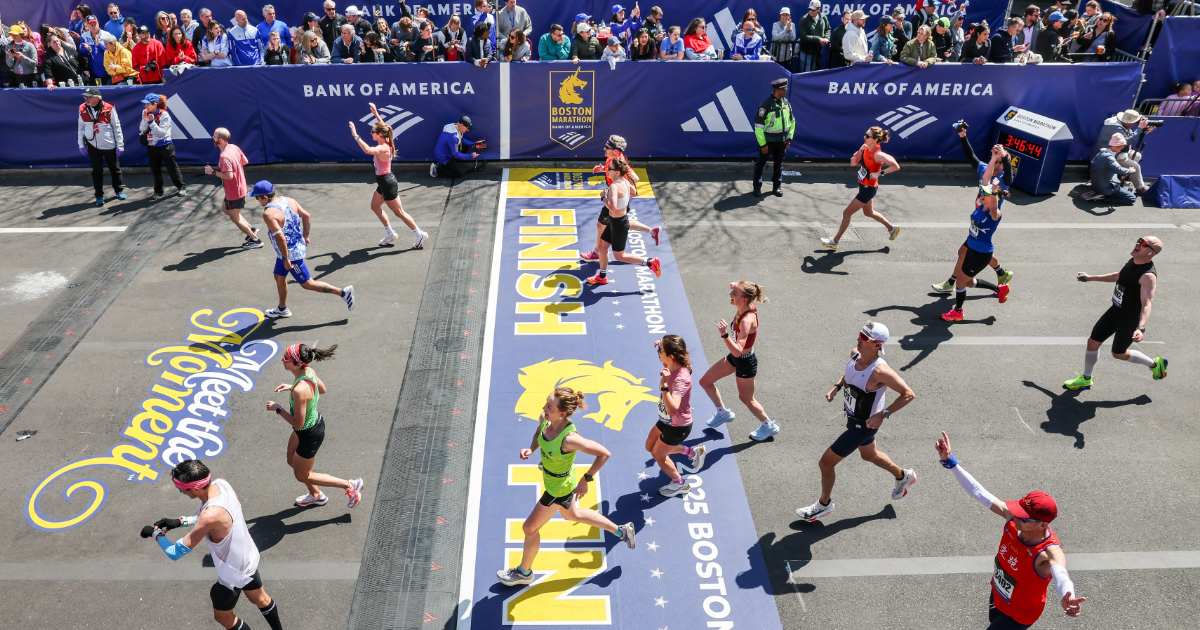
Race day will always be uniquely exciting, but it’s also confined to a tight schedule and a careful structure. Rolling dozens of buses full of nervous runners from Back Bay to Hopkinton to ensure that every wave kicks off on time is a monumental undertaking. Every inch of the course is covered in volunteers, EMTs, screaming fans, and crucially, college students that have been drinking since 7am. Marathon Monday is driven by a persistent manic energy that, under the best of circumstances, gets you from start to finish in personal-record time, but it can also feel like chugging five shots of espresso and licking a battery, all while having to pee 12 or 13 times in one morning.
Those long runs along the Commonwealth Avenue carriage lane have the same boisterous enthusiasm as race day, but with none of the pressure. Everyone’s starting on their own schedule and running their own pace. There are no waves; 2:12 pros and five-hour first-timers are all mixed up together in a beautiful organic melting pot. The leadup to a race constantly dogged with allegations of elitism or corporatism is remarkably egalitarian and community-oriented. All are welcome (as long as you don’t block anyone’s driveway and don’t litter your gel wrappers).
Boston has a reputation for at once being gruffly hard-nosed and icily patrician—and either way, unfriendly to outsiders. But you’d never know it if you found yourself in Auburndale on the morning of March 29th. Runners are waving and smiling to one another, cheerfully chirping “Good morning!” at dog walkers and stroller-pushers. There’s at least one volunteer wearing an inflatable dinosaur costume, handing out paper cups of water to folks raising thousands of dollars for Dana Farber, the Jimmy Fund, or some other equally worthy charity. Even the cars crossing the course seem less hurried, more deferential at each intersection; the dozens of pedestrians at each corner have successfully claimed unspoken authority over the roads that day.
Most Boston runners will think of the race as the reward and the training as a necessary evil. The last few weeks of a marathon cycle before a taper are a bit like Heartbreak Hill itself: the toughest stretch of training at the toughest part of the block, with the best part just over the horizon but still a long ways to go. It’s not the fun part, at least in any obvious way, but it’s special nevertheless. The eternal wisdom of Miley Cyrus, however cliche, rings true: It ain’t about how fast you get there; it ain’t about what’s waiting on the other side. It’s the climb.
David Melly
Since David began contributing to CITIUS in 2018, he's done a little bit of everything, from podcast hosting to newsletter writing to race commentary. Currently, he coordinates the social media team and manages both the CITIUS MAG newsletter and The Lap Count, supplying hot takes and thoughtful analysis in both short- and long-form. Based on Boston, David breaks up his excessive screen time by training for marathons, crewing trail races, baking sweet desserts, and mixing strong cocktails.