By Chris Chavez
April 27, 2026
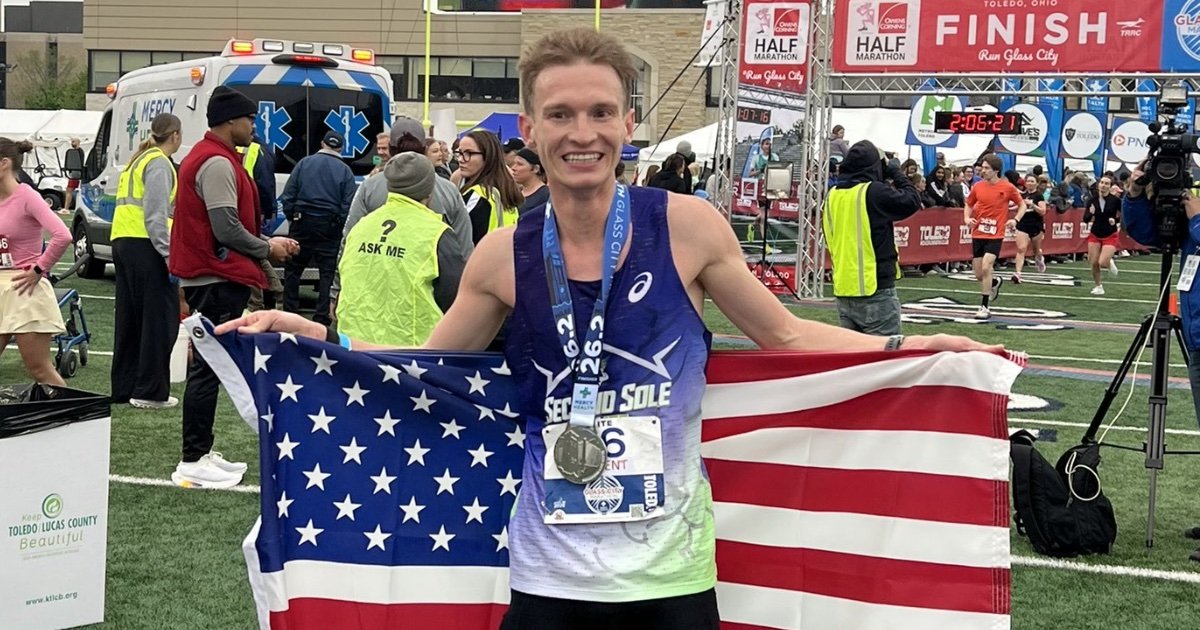
On Sunday, Vincent Mauri, a 24-year-old biomedical engineering graduate and part-time shoe store employee from Youngstown, Ohio, ran 2:05:53 in his marathon debut at the Glass City Marathon in Toledo. Mauri’s solid but not earth-shattering college pedigree and the fact that the old course record was 2:19:31 made this result arguably more surprising than Sabastian Sawe breaking the marathon world record in 1:59:30.
Sawe was the reigning London Marathon champion and threatened the world record before his Berlin Marathon run last fall. The world knew Sawe was good. The world had no idea who Mauri was. His performance on Sunday was the fastest marathon debut in American history. He did it entirely alone, without a pace group, without course clocks, and without a single half-marathon result on the books.
He is unsponsored and self-coached. The last result that pops up in TFRRS for him was the 5000m at the ACC Championships in 2025, where he got lapped by Ethan Strand and Gary Martin. His original target race this spring, the Carmel Marathon, was canceled three days before it was scheduled to go off. He pivoted to Toledo with a week's notice and ran 4:47 per mile for 26.2 miles without knowing he was running 2:05 until the finishing clock told him so.
To make sense of it all, we spoke with Mauri on Monday morning. You can listen to the full interview on The CITIUS MAG Podcast on Apple Podcasts, Spotify or watch it on YouTube.
His Background
Mauri began his NCAA career at Arizona State under coach Cory Leslie. At that point he was primarily a 1500 and 5000m specialist who put in serious mileage. COVID hit, coaching changes cascaded and injuries followed, even after transferring to Notre Dame.
His injuries included a tibial stress fracture at ASU, a concussion from getting hit in the face during the Nuttycombe Invitational while at Notre Dame, and during his senior year, what Mauri feared was a femoral head stress fracture that turned out to also involve a benign tumor on an MRI. He called the season.
In his six years of college, he only qualified for the NCAA Outdoor Track and Field Championships once and finished 18th in the 5000m final in 2022.
He volunteer-coached at Notre Dame briefly and tried to find a job in biomedical engineering but that didn't work out as planned. He eventually landed at Second Sole, a running store in Youngstown, where he'd been buying shoes his whole life. He started working there part-time, which crept toward full-time, and eventually fell back in love with running.
Planet Fitness, Double Threshold, and 22-Mile Sundays
Mauri has been working 30 to 40 hours a week at the shoe store ever since. Due to the this most recent brutal Ohio winter, many of his hard sessions happened on the treadmills at Planet Fitness. His long runs were solo affairs on Pittsburgh-area dirt roads. Much of his training follows an architecture he built himself by synthesizing the philosophies of every coach he'd ever had.
The structure consists of:
Two hard days a week — Sundays and Tuesdays.
Everything else was recovery but his easy running is done at 5:40 to 5:50 pace.
He spent three to four days in the weight room early in the build.
He averaged 110 miles a week.
His Sunday long runs ranged from 22 to 25 miles.
His signature session was a double-threshold Tuesday: a target of 100 minutes of total threshold work, split across a morning and an evening session — a 10-mile morning tempo followed by 8-minute reps at night if he felt good; two sets of 4 x 10 minutes if he didn't. Volume was the target. Pace was not.
He estimates that much of the first 800 miles of the year were mostly run indoors. He even used the machine to practice fueling, setting up four water bottles on the treadmill for a 19-mile session.
Almost none of the training was done in plated shoes. Mauri estimates he ran perhaps 25 total miles in carbon-plated footwear during the entire build—a short local half, one mile of a workout, a four-mile store race in January.
"I can count on one hand the number of times I trained in plated shoes the whole build. Maybe 25 miles total. The idea was: if I can run sub-5:00 pace in an unplated trainer, I know I'm getting something extra on race day."
The Race
His original marathon was supposed to be the Carmel Marathon in Indiana. He picked it partly because his Notre Dame teammates were nearby and he figured he'd race, stop, have dinner with everyone, and drive home. Then, three days out, Carmel was canceled.
His colleague at Second Sole's Toledo location offered him a spot in the Glass City Marathon the following week. The extra week turned out to be a gift. He'd been running 110-mile weeks and had barely felt the taper yet. Now the taper hit and every run was feeling easy.
Mauri's race plan was simple: See if he could run 2:09, maybe squeeze down to 2:08. He targeted the first 10K at roughly 4:55/mi pace and treated the race as a series of 10K segments. He had converted the 26.2-mile race into an 18-mile race in his head, because 18 miles was a number he'd run repeatedly on long runs.
The Glass City course had no clocks. His watch showed average pace and current pace—nothing else. After the first 200 meters, the field was gone and he was alone, running through the Toledo metro parks with a camera operator on a golf cart for company. He tried to make conversation for the first two miles. Then he settled in.
For most of the race, he was seeing 4:50 to 4:55 on his watch. Then 4:45 to 4:50. By the final miles: 4:46, 4:47, 4:48. He knew he was running fast. At 30K the math stopped working and it became about getting to the next bottle station. At Mile 22, he told his friend that his legs were getting closer to the ground than he'd like. He took half a caffeinated Maurten gel and held on. He entered the finishing stadium and looked at the clock. He thought it said 2:09. Two seconds later, he realized it said 2:05.
The Aftermath
The result was so surprising that a wave of skepticism hit almost immediately. People on message boards called the course short. Mauri's response was unfazed: " Go look at my Strava,” he would say. The training data is all there.
He reached out to USADA asking about any testing and was told that drug testing is only required for American records and world records so he wasn't tested. He made a public offer to welcome testing at any time.
His phone was going crazy for much of Sunday. He was on the local news in Toledo, then it hit Youngstown. He saw people he had raced in middle school at the finish line. People called whom he hadn't heard from in years. His parents, who hadn't seen him race in a long time, had been at the 5K mark. He was smiling.
The morning of his race, he had no idea a sub-two-hour attempt was happening at the London Marathon. The London field was roughly halfway through when Mauri started his warmup.
He found out after the finish. "I guess it was just a good day to run a marathon," he said.
Keep up with all things track and field by following us across Instagram, X, Threads, and YouTube. Catch the latest episodes of the CITIUS MAG Podcast on Spotify and Apple Podcasts. For more, subscribe to The Lap Count and CITIUS MAG Newsletter for the top running news delivered straight to your inbox.
Chris Chavez
Chris Chavez launched CITIUS MAG in 2016 as a passion project while working full-time for Sports Illustrated. He covered the 2016 Olympics in Rio de Janeiro and grew his humble blog into a multi-pronged media company. He completed all six World Marathon Majors and on Feb. 15th, 2025 finally broke five minutes for the mile.