By Paul Hof-Mahoney
July 15, 2026
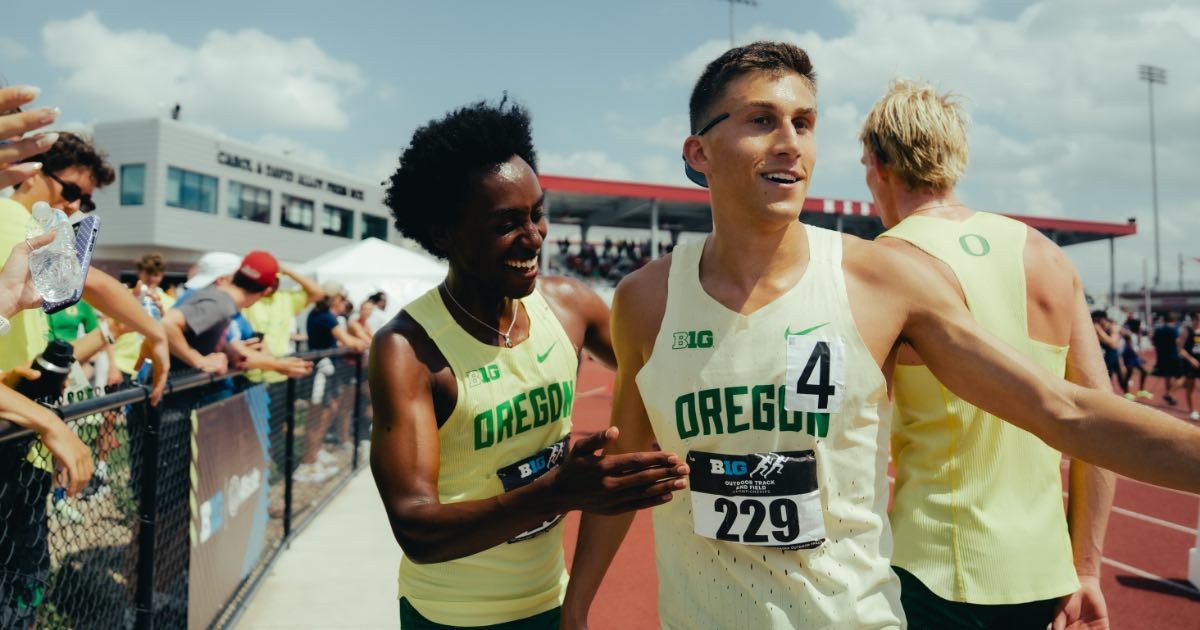
A member of 10 Big Ten Championship-winning teams across four years at Wisconsin and two at Oregon, Evan Bishop has joined Bandit’s Unsponsored Project ahead of the 2026 U.S. Outdoor Championships.
Started in 2023, the Unsponsored Project is Bandit’s aim to support athletes without major shoe contracts, providing them an unbranded race kit and funding for travel, lodging, and a wide range of other needs. To date, 12 athletes in the Unsponsored Project have gone on to sign pro contracts.
Bishop ran personal bests of 27:57 for 10,000m and 13:37 for 5000m this outdoor season, scoring 10 points for the Ducks’ team conference titles across indoors and outdoors. He also finished a strong fourth at the Big Ten Cross Country Championships in October. He’ll enter next week’s U.S. Championships as the sixth-fastest American over 10,000m this year.
Bishop sat down with CITIUS MAG to discuss his eligibility limbo, overcoming a frustrating 2025-26 season, and looking ahead to a future on the roads that will come sooner rather than later.
The following interview has been edited lightly for length and clarity.
CITIUS MAG: You just graduated from Oregon last month, what has the transition into post-collegiate life and post-collegiate running looked like for you in the month since NCAA West Regionals?
Evan Bishop: It’s been a year with a lot of trying to get some answers and a lot of gray area as you’re trying to figure out that next step. Right now actually, the school is trying to battle to get me another cross country season, so I’m trying to figure out if I’ll be coming back and running a cross season and then taking the next step and figuring out what the set up will look like.
With the way your cross country and outdoor seasons ended, I know there’s maybe a little bit of a bad taste in your mouth right now. Can you talk about what those experiences were like and how you work past those while keeping your love for the sport?
It’s been a really difficult road, and I think most athletes have experienced the same thing—you have the highs and the lows. Track is a sport where you can work so hard and be in a perfect position, and then you’re just reminded how fragile it is.
In the fall, Abdel [Laadjel] was my main training partner and he ended up getting ninth at NCAAs, and we were going back and forth throughout that season. The team was in a position to maybe win a national title. The week before the NCAA meet, my sacrum broke. I had never had a bone injury before, and I’m getting older now so I thought I was immune to those, but not quite. I got a little sick and was dumb with how I was fueling, and I learned a lesson the hard way.
My dreams felt like they were literally in my hands in the fall. I was gonna be probably top 15, maybe top 10, somewhere in there, and on my way to a great year the bone injury happened. So from there, you try and reorient your plan.
I was pretty aggressive with the return to run program, my sacrum was still hurting pretty bad, my knee blew up. I was taking all these risks to get back to fitness so I can have a chance for one more shot in the outdoor season. I was able to run a pretty good 10K off of just four weeks of workouts, a sub-28 race at Stanford. I was like, ‘All that training, all that work I’ve done, years of work is finally maybe going to show through this year.’
Then I got super sick the week between Big Tens and Regionals. One of my teammates had a really bad stomach bug at the Big Ten meet and I must’ve picked it up. The four days going into the Regional meet, you can’t afford to not be mostly all the way there. I was trying to pull a flu game out of my ass. But when you’re trying to run a 10K, you don’t get a lot of forgiveness there.
I made it 23 laps, I made the breakaway, I was in the 12, I was just trying to will my mind over my body. Pretty heartbreaking when I slid back into 13th and my body was just shutting down. Now I’m kinda starting to once again pick up the pieces and remember all the other good things you get out of the sport. I realized that I still really love the sport, and I know there’s so much more there. It’s a question of how do I look forward rather than look in the past and be sad. It’s time to use motivation and go prove it at the next opportunity, and that’s why the Bandit thing is really cool.
You got back on the track a few weeks ago at the Portland Track Fest, running a 1500m. What was the mindset in putting that one on the calendar?
After Regionals, I was in great shape, and we were trying to figure out what made the most sense in terms of this summer. This year, I really wanted to do a track season for the first time late in the summer, go to Europe and keep running into August. The 1500m is super fun, I wanted a break from the longer races and the shorter the race, the more fun it is. It was kind of a tune-up, good for training, but what we realized from it is that my body was so flat and fatigued.
Coming from Regionals, I forced it into this big hole trying to do that all-out 10K on a body that was really sick and depleted, and then come back and also try and run the 5K. Those three weeks between Regionals and Portland, things weren’t really clicking and I felt like I was forcing it. Again, things are so frustrating when your mind wants one thing. In my mind, I was already gonna be a three-time All-American this year, have these great times, and go to U.S. Championships and have this late track season, but then you have to keep readjusting that.
We took some time down after that, and we had a plan to shut it down and take some time off, still go to USAs, but kind of build for the next chapter and phase, and it looks like that’s probably gonna be a cross season.
10 days out from USAs now, are you feeling alright about how that’s gonna go? Is it just a big question mark?
I’m excited. I took some time down and this is now week two of my mileage build for the fall, so I’ve just done easy running, high mileage stuff, a couple strides on two of the days. I’m really curious to see how it goes. My body really needed a break, I think, it had been a long, grueling year. It’s definitely not ideal, in your mind you’ve been doing track workouts and racing all through the U.S. meet, and that was my Plan A. It’s gonna be interesting. I’m excited to line up and give it all that I have, I’ve earned my spot on that line and it’ll be a really cool experience.
Jerry [Schumacher] and I had this long talk at Hayward out in the sun, and for the opportunity to run to come together, the fall will be most important. At the U.S. meet, it’s an off year and there isn’t any team to make, and I want to run really well there, but we want to play my cards as best we can so I have the opportunity to continue running after college.
You seem pretty confident in the fact that this extra cross season will come through, but is there any sort of discomfort around the uncertainty of that situation still? That Regional meet could’ve been the last of your NCAA career, or you could be spending another year in one of the best supported teams and programs in the country.
Yeah, it’s killing me. I’m not super Type A, but I do like to have a plan. Like I’m leaving Wisconsin, I’ve got this scholarship at Oregon, this is my plan. Or I’ve got an internship next summer, that’s the plan. This year has been tough because I don’t have a plan and everyone keeps telling me it’s all going to fall into place and to be in the moment, and I’m trying hard to do that.
But it’s hard not knowing if I’m coming back for the fall or if I’ll be working a 9-to-5 and trying to start a marathon career. I’m excited to have answers and more clarity on what the next chapter will look like.
You mention marathoning, and that’s a route we see people going to earlier and earlier now. Is that the next move for you post-collegiately even if the cross season comes through and goes well?
That’s something I’m really excited about. It’s hard because I love the track too and I know I’ve got unfinished business there. So maybe it’d be like one more year with a track season, but eventually I know for sure before I move on from the sport, I want to give the marathon a real honest go before I move onto the next chapter in life. I think the ceiling there is really high. That’s what Jerry had talked about. He says, ‘From what I’ve seen, there have been some crazy long runs and some really good aerobic work where you can run 4:35, 4:40 forever. I'm not blowing smoke up your ass: you could make an Olympic team in the marathon.’
I always told myself if I was going to run after college, if there was at least a one percent chance I could make a team, then it’s worth it. If there’s some hope, I want to keep chasing it. With the marathon especially, it seems like there’s the most upside there with what I’ve shown in practice and workouts. But obviously you won’t know until you do it.
What is the best long run you’ve done that most makes Jerry believe that?
There was one day where it was pouring rain and we had a long run, I was just in Nike Pegasus’. The bike path had layers of water. It reminded me of the Boston race that Des Linden won, it’s one of those days in Oregon in the late fall. I just started rolling, and I didn’t have any fuel, and I think I averaged like 5:17 or something for 18 or 20 miles. I can kind of crank those off like that. There was another one I did at home where it’s 18-20 miles and I’m just running five-flat for the last 10 miles. Once you get into that rhythm, it feels like a flow state. And if you can run a little quicker than that, then we’re talking.
When you talk about that potential 9-to-5, what would that be for you?
That’s another thing I’m still trying to figure out. I ended up doing finance and supply chain in undergrad, but I started kinesiology. I was thinking maybe PT or something on the medical route, so I have a lot of the med school prereqs knocked out. And then my grad program here is in sport product management, so it’s basically like an MBA, but you learn everything that goes into making a Nike Peg or a Vomero. It’s a pretty cool program.
So I think between my experience working in finance for Dell for a summer, I got a Nike internship and was at Converse for strategy and supply chain, and then this grad program that makes me qualified for product roles, I’m trying to merge those into something in the sport product role. I’d love to be a PLM, a product line manager, but they’re hard to get.
You’re kind of in an in-between space right now, but with momentarily transferring out of the collegiate world, how important is being part of Bandit’s Unsponsored Project right now as you look towards USAs?
It’s been huge and really exciting. Having anybody that’s interested in keeping your dreams alive, it’s awesome, like “Thank you!” What’s cool for them is seeing the athletes they support through this project that end up getting contracts and getting to chase their dream longer, it’s cool to see a brand doing that, honestly.
There’ll be a lot of people wearing Bandit at USAs, with the Unsponsored Project roster well over 70 athletes. You’ve been a part of so many great teams, how excited are you to have a continuation of that in some way at a U.S. Championship?
Being in a position where there’s 70 other people who are likeminded, doing the same thing — making ends meet however they can, probably all coming from very different places whether they’re leaving college or working jobs — and all trying to do the track and field thing is really cool. Being a part of a team is the best, most rewarding and enriching part of doing this whole thing, and that took me a while to realize. Being a young, dumb freshman, you think you can do it alone and all that matters is going pro. Then you realize all the best memories are with your teammates and the lifelong friendships you built.
Bandit has put a team together, and I’m sure people are going to be able to connect with each other and find community in a similar shared pursuit.
Before we go, you feel uniquely qualified to answer this question as someone who spent four years at Wisconsin and now two with Oregon. How do you think Chris Solinsky is going to do as the head coach in Madison this year?
That’s my boy! I think he will hit a home run there, I was super excited to see it go to Chris. He ran there, he lived in the same college house I was in—his room was across from mine in the basement. Chris is going to bring that history and appreciation for being an athlete in that program, which is really cool, and then obviously he’s had a lot of success as an athlete, but a lot of great athletes don’t make great coaches. He ran 26 minutes in the 10K, but then he’s one of the best, if not the best, coaches I’ve ever had an interacted with. He really cares about you as a person, and holistically, it’s really good.
He’ll have his work cut out for him. Jerry’s not going to make it easy on him going to head-to-head with Oregon, but I’m excited to see what he can do in Madison.
Keep up with all things track and field by following us across Instagram, X, Threads, and YouTube. Catch the latest episodes of the CITIUS MAG Podcast on Spotify and Apple Podcasts. For more, subscribe to The Lap Count and CITIUS MAG Newsletter for the top running news delivered straight to your inbox.

Paul Hof-Mahoney
Believe it or not, his last name isn't actually “Throws”! Paul is CITIUS’s throws analyst and is currently a student at the University of Florida. When he's not posting his Fact of the Day just before midnight, Paul is trying his darnedest to become a runner (5K PB currently sitting at 26:29) and probably complaining about living in Florida. He'd like to thank his girlfriend and CITIUS digital producer Audrey Allen giving him free photos and videos of throwers and YouTube thumbnails to help build a facade of professionalism around Paulie Throws.