By David Melly
July 23, 2026
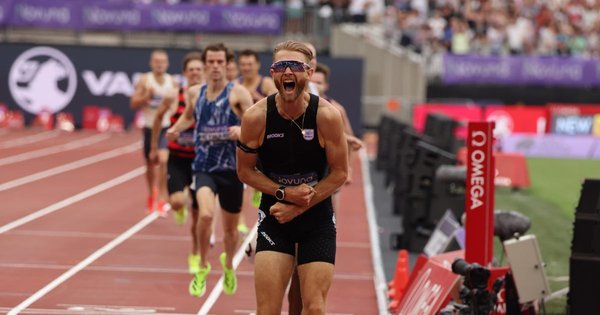
It’s not often in the sport of track and field that you can hear the roar of a crowd through your television screen. But with one lap to go in Josh Kerr’s audacious record-setting mile run at the London Athletic Meet, the Olympic Stadium was as loud as any World Cup match.
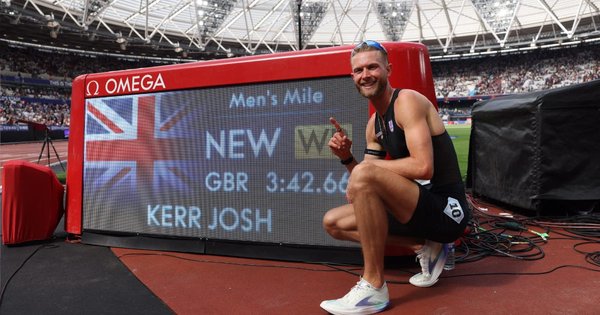
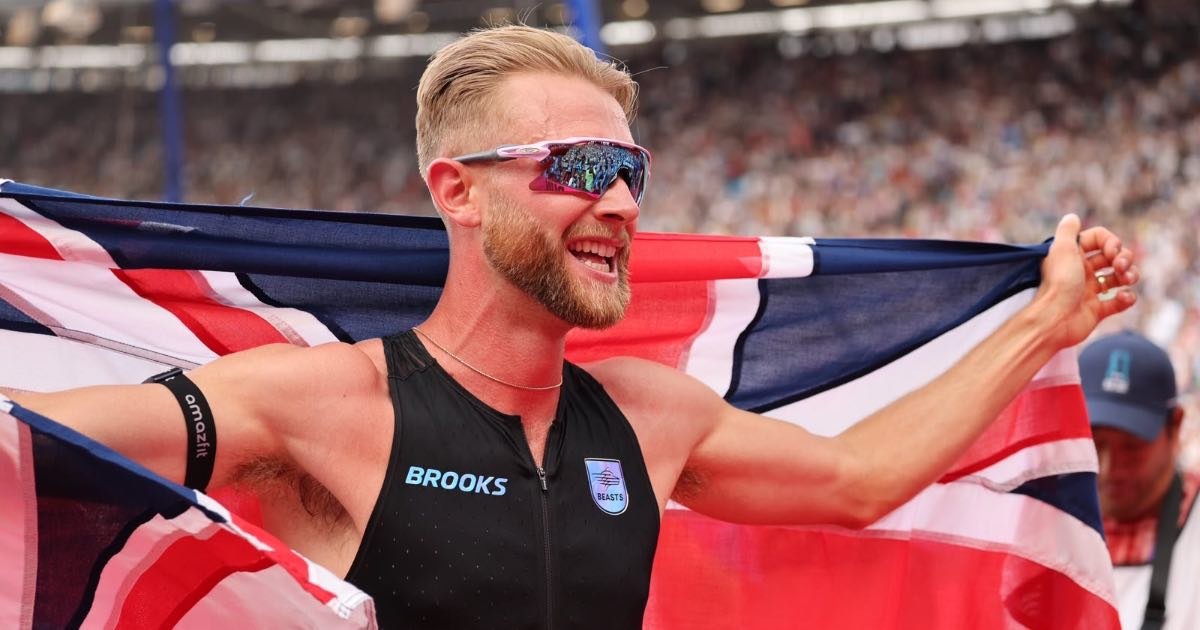
Spurred on by 60,000 or so screaming fans, Kerr was able to pull away from runner-up Yared Nuguse and go where no man had ever gone before, stopping the clock at 3:42.66. In doing so, he became the first man under 3:43 in history and knocked Hicham El Guerrouj off the top spot for the first time in 27 years.
Behind Kerr, Nuguse held on for second in 3:45.69 and Jake Heyward continued his improbable comeback season, setting a Welsh record of 3:46.73. Heyward missed three straight seasons to injury, and now he’s back to his best stuff in half a season of racing. Robert Farken rounded out the most cheer-worthy performances by breaking his own German record for the second time this month, running 3:46.82 for fourth.
Around Kerr was another thrilling Diamond League meet, headlined by a red-hot Julien Alfred, who defeated Olympic champ Gabby Thomas over 200m once again, running a new meet record of 21.66 to Thomas’s 21.81. In the men’s 100m, NCAA champ Kayinsola Ajayi caused quite a stir with his finish line staredown of World champ Oblique Seville (or was it Jordan Anthony?), which didn’t slow him down too much because he still won the race in 9.84 into a headwind. Ajayi’s Auburn teammate Ja’Kobe Tharp re-proved his NCAA performance was no fluke, as he picked up his second of two 110mH wins on the pro circuit last week. Running 12.89 in London and 12.85 in Budapest in an incredible display of high-level consistency. And British fans will surely be throwing their tea and crumpets at the screen right now because we got four paragraphs in without mentioning Keely Hodgkinson’s 1:56.21 win in the 800m.
The theme of the field events was shocking losses, as Mondo Duplantis withdrew early from the pole vault program with hamstring tightness and ended up fourth, while discus queen Valarie Sion threw well, but not well enough to counteract Cierra Jackson’s surprise Diamond League record in the discus. Last year’s NCAA champ launched an absurd 71.72m sixth-round throw in the discus to defeat the reigning champ and log the longest throw in the world outside the wind tunnels of Oklahoma in nearly four decades.
But you’d never know any of this happened from the headlines, because the media firestorm that followed was all Josh Kerr, all the time.
Deservedly so!
Kerr can be a polarizing figure for his public bravado and seemingly impregnable ego, but if you’re going to take the incredibly vulnerable risk of calling your shot four months in advance, you deserve the literal and metaphorical victory laps that follow.
Kerr’s 3:42.66 seemed to accomplish two rare feats: it broke through to the broader sporting public’s consciousness, making its way into ESPN push alerts to Twitter clip farms, and it captured the full attention of the hard-core track and field fandom in a way that few events outside an Olympic final can. The physical achievement itself is all the more impressive because of the way it was successfully framed and presented to the world as a moment, a where-were-you-when phenomenon that will live on as one of the defining achievements of both the track and field year and Kerr’s entire career.
So how’d he do it? It’s one thing to put in the training and harness the technology necessary to get into world-record form, but it’s another to win the marketing and promotional game as well.
One key factor has already been mentioned: Kerr’s been telling us about the “Project 222” endeavor for months. Full entry lists for Diamond League meets are rarely available more than a few days in advance, and athletes are (unfortunately) under no professional obligation to tell fans what races they’re running until they get to the start line. Yet we’ve known since March that Kerr was running this race, on this day, and what his stated goal was. That allows for months of speculation by fans and analysts alike, dissecting workouts and cross-referencing splits to gauge Kerr’s chances of both victory and record-setting success.
Typically, track and field endeavors flicker in and out of our brains in a matter of seconds, with last weekend’s meet quickly subsumed by the next surprise PB or big upset. But sports more generally thrive on narratives that fans can sit with, and a mile world record attempt is just as worthy of sustained public attention as a 41-year-old’s free agency journey.
Since March (and actually, fairly consistently for the last several years), Kerr has rigorously documented his buildup. Again, the lack of professional obligation to tell the world anything about your health and training means that there’s an enormously wide range in how forthcoming professional track and field athletes are, with some posting daily runs on Strava and others dropping off the face of the planet for years. Kerr, like many of his rivals, has harnessed the power of YouTube effectively to keep fans interested and drop new tidbits of information to help shape the story. If there’s one criticism to his media strategy in the leadup to the race, it would’ve been nice to officially know about Kerr’s 2:42 1200m time trial at altitude sooner than the day before the race, because that would’ve really helped the pre-race frenzy.
Kerr’s selection of the London Diamond League as the venue of choice was also an audacious, but critical, ingredient in the recipe for success. He was not only inviting all challengers (at least those that could acquire a bib for a DL meet), but he removed any sort of asterisks that have become all-too-common place in these much-hyped record attempts. By opting to compete at a real race rather than a brand-sponsored exhibition, he was not only making sure the record itself was official-official, but that the entire endeavor felt performance-forward.
Surely the higher-ups at Brooks would’ve preferred a few more logos, and there’s plenty of “project” precedent—whether it’s Nike’s various Kipyegon/Kipchoge exhibitions, Jim Walmsley’s 100K Hoka time trial, or the Adidas “Road to Records” events. Even within the bounds of official competitions, there’s a wide range of perceived legitimacy. But with all due respect to the BUs and UWs of the world, it’s so much more satisfying to watch a record fall on an international broadcast of a 73-year-old professional meet than a half-empty college track.
London itself proved once again why it’s one of the track and field athletics capitals of the world. There’s great value in bringing track to new and exciting places where it doesn’t have a pre-existing footprint, but just as important is honoring the tradition and history of one of the world’s oldest sports. If your goal is to maximize in-stadium energy, choosing the place that delivered two of the best track and field events of recent memory—the 2012 Olympics and 2017 World Championship—as a homecoming for the most decorated UK distance runner since Mo Farah (Editor’s note: or second-most, depending on how you stack up Kerr’s resume against Hodgkinson’s) is a brilliant move.
Then there’s the goal itself. Taking down an El Guerrouj WR was no cakewalk, but despite being 27 years old, the 3:43.13 mile was arguably one of the more gettable marks on offer. Per the World Athletics scoring tables, 3:43.13 is “easier” than the 800m, 1500m, 3000m, and 5000m marks; it and Emmanuel Wanyonyi’s newly-set 1000m record are the only male distance records worth less than 1300 points.
3:43.13 is 3:28.01 1500m pace plus 109 meters; seven active runners including Kerr have run faster for 1500m. When Jakob Ingebrigtsen came within a second of the mark in 2023, his PB at the time was 3:27.14. Running 3:42 is something few men will ever be capable of, but it also doesn’t necessarily require being in 3:26-low 1500m shape.
The net result was an event built for success. An ambitious, but achievable goal teased months in advance, with repeated drips and drabs of new information to build interest dropped along the way. A perfectly-packaged showcase with the UK’s best miler headlining the UK’s biggest meet, while still preserving the high level of competition and elite standards essential to the race’s credibility. A generational athlete with a love-him-or-hate-him persona, evoking strong emotions from his fervent supporters and biggest detractors alike. And of course, the run itself; Kerr was able to blossom, not wilt, under the bright lights as he has at championships going back to NCAAs in 2017.
Few track and field moments will be able to match this one’s alchemy, but more should try. Josh Kerr deserves a lot of credit for putting his reputation on the line to create must-see TV, and even more for delivering. Whether his record stands for two more weeks or 27 more years, it’ll eventually be broken, but the thrill of that roaring crowd will last forever.

David Melly
Since David began contributing to CITIUS in 2018, he's done a little bit of everything, from podcast hosting to newsletter writing to race commentary. Currently, he coordinates the social media team and manages both the CITIUS MAG newsletter and The Lap Count, supplying hot takes and thoughtful analysis in both short- and long-form. Based on Boston, David breaks up his excessive screen time by training for marathons, crewing trail races, baking sweet desserts, and mixing strong cocktails.