By Kyle Merber
October 28, 2026
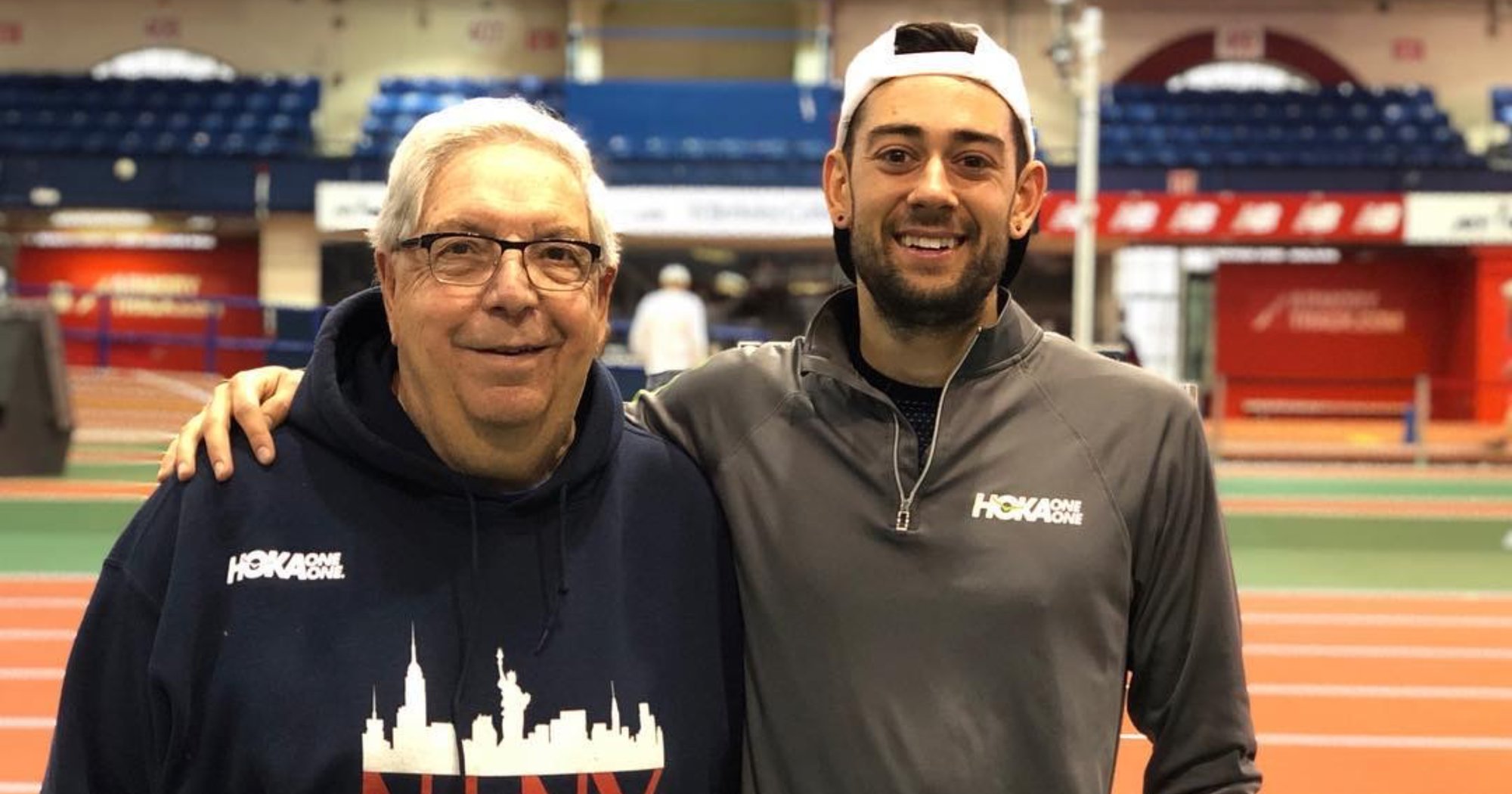
When I saw Gags at Icahn Stadium this summer as he was honored at the U.S. Championships, I figured that saying goodbye that day would be my last chance to do so. Surrounded by love and laughter from family, friends, fellow coaches, and dozens of his former athletes, it was no secret that the man we all knew as an indomitable force and a booming voice was making the turn onto the final straightaway.
I wanted to repeat the same words that he always bellowed to generations of athletes (“go to the elbows!”), but mainly, I thought of something he had told me many times: that he was proud of me.
Coach Frank Gagliano passed away on Sunday at 89 years old. Most men of that age would be fortunate to have a few friends still around to check in and express their gratitude, but Gags wasn’t most men. It was a familiar scene at Icahn—something I’d witnessed countless times, whether at the Penn Relays, The Armory, or Princeton—a steady procession of people waiting their turn to visit the Godfather to say thank you for a favor, ask advice, or just say hello.
Across a career that took him from Roselle Catholic, to Manhattan College, to Rutgers, to Georgetown, to the Enclave, out west to the Farm Team, then OTC, and finally back home to lead the New Jersey-New York Track Club, Gags coached a thousand athletes. Every one of them has stories to tell about the impact Gags had on their lives.
This is my story.
I first met Gags during the indoor season of my senior year at Columbia University. I jumped into a workout at the Armory with some of the guys on his team and experienced his coaching firsthand. Later that spring, I ran fast enough to get the attention of teams, agents, and brands. As a New Yorker, my first choice would have been to stay home and join NJ-NY. So I asked Gags if he would coach me.
He said no.
I had already committed to finishing up my collegiate eligibility at the University of Texas. Gags, always a fan of the NCAA and of keeping one’s word, told me to go continue my education in Austin and that he’d be waiting for me when I was done.
One year later, I asked again. This time, Gags told me to come home. The difference was that after a tough year of injury and underperformance as a Longhorn, I no longer had shoe companies banging down my door. NJ-NY could offer me a room in a house in Clinton, New Jersey, with six other guys and a stipend of a few hundred bucks a month. With Gags’s assurance that if I got a part-time job and worked hard I’d be alright, that was enough.
There aren’t many teams like the New Jersey-New York Track Club anymore, and that’s probably because there aren’t many coaches like Gags anymore. My “recruiting class” is not one you’d see join any professional roster today. Leading the way were 2012 Olympian Donn Cabral and two-time NCAA champion Robby Andrews, along with a couple of guys like me—runners who had a few big performances to their names and who never won anything above a conference title. But there were also many more you haven’t heard of who never qualified for an NCAA meet or even Regionals in some cases.
To Gags, it didn’t really matter how fast you were; it was about how much faster he could make you. His teams, for as far back as I’ve heard, operated sort of like an all-comers practice. If an athlete was willing to show up and consistently put in the work, he’d let them ride the train for as many intervals as they could hang for. If you never saw Gags in action, you probably think it’s hyperbole, but how fast you were really didn’t factor into the equation of how much he invested in you.
When I first joined the team in 2013, my running was not in a good place. At an early practice, I was falling off the pace, and Gags laid into me. Like, really, truly yelled at me. To say I did not enjoy that would be an understatement. When I was leaving practice that day and he tried to comfort me, I snubbed him. I was furious. Not just at him, but because my body was nowhere close to where it needed to be, and the frustration from the previous year was still raw.
When Gags called me that afternoon, we had a heart-to-heart. There were teammates of mine who needed that style of coaching and thrived off it. But I told him that I don’t respond well to being shouted at, and that he would never need to question my motivation or how badly I wanted to be great.
Despite having a roster of 40+ athletes, Gags heard me and adjusted the way we worked together. For the next seven years, I didn’t have a coach as much as I had a partner. I know I was high maintenance, but I liked hearing why we were doing certain things; understanding helped me believe in the process. As our relationship and trust grew, Gags would appease me by confiding the week’s plan.
A good coach knows how to respond to an athlete, and that’s what Gags understood. Putting strength and speed in a bowl and mixing it up to make a champion didn’t require rocket science. The training philosophy was simple yet logically progressive, and that was the beauty of it. But the true differentiator was the way he knew when to push and when to pull. It’s a long year, full of dozens of races and God knows how many workouts, and what Gags did best was know when it was time to ramp things up and when to just have fun.
I still have an old email saved where he wrote: “The big thing is you must do the little things with no intensity.” His most consistent reminder was to live life like a clock.
Once, during an early-season indoor meet at The Armory, I went out hard, blew up remarkably, and my last lap bordered on a walk. The next morning, a 6:00 AM voicemail was waiting for me: “Merber, you had a great career. I am proud of you for trying and appreciate all you’ve done for the team. Stop by practice tomorrow and hand in your jersey. Wishing you all the best in what comes next!” Then he cackled with laughter and hung up.
Running for Gags was like joining a benevolent fraternity, and to be known as one of Gags’s guys was a badge of honor. His legacy and influence won’t be limited to the training, because I’m sure most of his athletes remember him even more for the way he cared.
Looking back on our messages, we spoke more during the tough times than when I was running my best. After surgery when there was nothing to do but rest, it was nonstop. At a time when some coaches might forget about an athlete is when he stepped up—when we needed it most.
As badly as I may have wanted to run fast and win races, I also ran for Gags. In post-race interviews, his athletes would often say “we” because they knew they were never alone out there. And as the outpouring of love and stories from Gags’s life are shared this week, there is comfort in knowing that none of us are alone in missing him dearly.

Kyle Merber
Kyle Merber is a former professional miler turned media multi-hyphenate. While he’s not above dropping a quick “back in my day,” he’s far more focused on the present. Since 2021, he has brought his signature analysis and commentary to track fans across the CITIUS MAG network. When he’s not writing The Lap Count or hopping on podcasts, Kyle manages partnerships and pitches a relentless stream of ideas for Chris to consider. He might not be running a 3:52 mile anymore, but he keeps himself in just good enough shape to ensure the athletes still respect him.