By David Melly
July 1, 2026
Heading into last Sunday’s Diamond League meet in Paris, the headlines were dominated by questions over whether the meet would even happen amidst France’s historic heat wave. After a few days of back and forth with city officials, the show did go on, with the distance races shifted to the end of the program and crowd-cooling efforts underway.
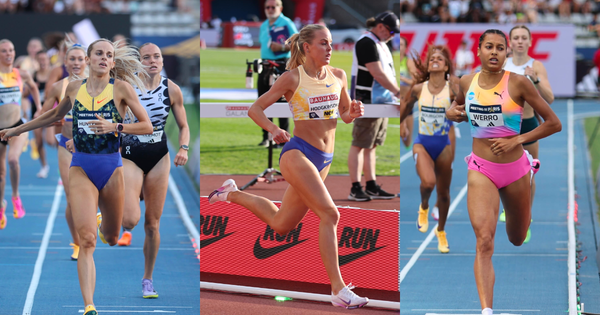
By the first commercial break, any weather-related concerns were a total afterthought as the real heat was happening down on the track. The first two events resulted in Diamond League records as Collen Kebinatshipi scorched a 43.54 400m and Audrey Werro clocked a 1:53.80 800m, her second league record in as many weeks.
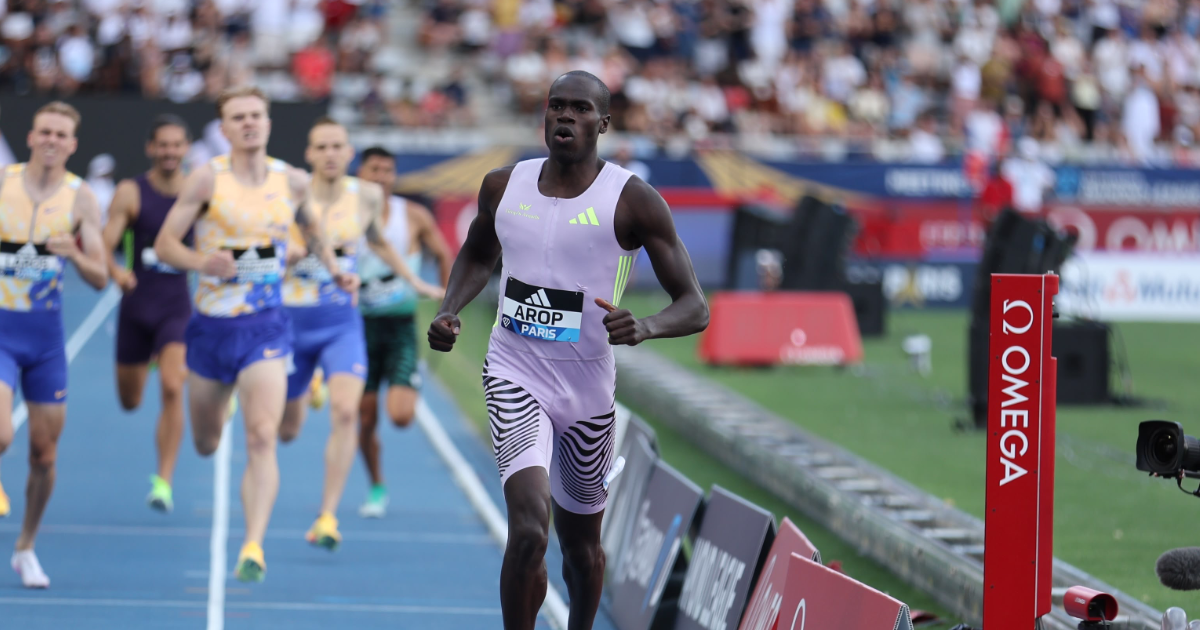
Later in the program, Marileidy Paulino added her name to the DL record books with a 48.48 run in the 400m, winning by a country mile and clocking the fastest regular-season time of her illustrious career. Even in events where no record fell, we still got the first sub-1:42 of the year thanks to Marco Arop in the 800m and a world-leading 3:28.00 from Cam Myers in the 1500m.
After getting stuck at 13.07 for two years, Jamal Britt has now run sub-13 in three of his last four 110m hurdles races, the most impressive of which coming in Paris as he cracked the top-ten all-time list with a 12.89 personal best. The flat 100m wasn’t quite as impressive, timewise, but what did get a few folks talking, including Noah Lyles, was Trayvon Bromell’s 9.91 win out of lane eight.
The home crowd had plenty to cheer for, especially with middle-distance runners Anaïs Bourgoin (1:55.65) and Agathe Guillemot (3:56.24) setting national records in the 800m and 1500m, respectively. Guillemot held the record already, but in knocking over a second off her lifetime best at age 29, Bourgoin also took down a 31-year-old mark from Patricia Djaté-Taillard.
Their runs, combined with an impressive 5.93m showing from Baptiste Thiery in the pole vault (winning the non-Mondo division), probably made up for a slight disappointment from World 10,000m champ Jimmy Gressier, who finished a well-beaten seventh in the 5000m. Instead, the loudest cheers were from U.S. track fans (or maybe a few Franco-Americans from Maine or New Orleans with divided loyalties) when Grant Fisher finally earned his first career Diamond League victory after a handful of second- and third-place efforts. After his brief, mixed-bag dalliance with the half marathon, it was oddly comforting to see Fisher looking like himself, unleashing a perfectly-executed 54-second close to clock a 12:54.80, the ninth sub-13 of his career.
Diamond Leagues are fast—we get it. For better or worse, the nebulous points system and ranking implications for World Ultimate take a back seat when the fields are strong, the pacing is well-executed, and the Wavelights are humming. Everyone both competing and watching cares first and foremost about running a fast time, which is arguably a bad thing in the long run, but when fast times come, it sure is thrilling.
But this particular meet at this particular point in this particular season delivered flames top-to-bottom in a way that stuck out, and it’s pretty clear why. The lack of a World Championship (at least in the traditional, nine-day format) opens up the menu of racing options. If you’re the kind of top athlete who doesn’t care about indoor and doesn’t have to worry about actually winning your national championship (i.e. non-Americans, East Africans, and Jamaicans), you suddenly have a pretty boundless calendar in terms of when you want to peak and deliver your best stuff. For some athletes, that might be WUC, Europeans, or Commonwealth Games. But even then, there’s plenty of space to circle a line on the record book and focus on crossing it off.
Look at the way the middle-distance races played out. Days in advance, Werro was talking about following the pacer out at 55-second pace—and that’s exactly what she did, pulling Femke Broeders-Bol and the field along with her as seven of the top eight finishers set PBs. In the men’s 800m, Arop simply didn’t have the competition to push him without Emmanuel Wanyonyi or Cooper Lutkenhaus in the field (Editor’s note: it still sounds insane to put Lutkenhaus in that sentence), but he went for it nevertheless, putting a massive gap on the field around 500 meters that was never clawed back as he ended up winning by nearly two full seconds.
Despite the men’s 1500m not being an official DL event, Cam Myers was clearly rearing to go after finishing second and third in two more middling races earlier on the circuit. The 20-year-old Aussie stuck to the rabbit like glue and then ran the legs off runner-up Azeddine Habz in the final lap. That was the race of a man who knew he had a fast one in his legs and wasn’t content to take the win in a kick. As a result, while everyone else ran 3:29+, Myers knocked 1.8 seconds off his PB, took down Olli Hoare’s national record, and climbed to #12 all-time. Sub-3:30s are becoming increasingly commonplace in the mid-2020s, but only six men have run faster than Myers since 2020, and of those six, three are World/Olympic champions.
The freedom afforded by not scheduling your entire year around three rounds of racing in September has a leveling effect on the rest of the track and field calendar. Not everyone is at their peak fitness in June, but way more global-medalist-types are in 2026 than they would’ve been last year. Mid-summer has always been a somewhat fruitful time for time-trialing, particularly at the Parises, Romes, and Monacos of the world, but the shifted incentive structure of a “non-championship” year elevates those races much higher on the totem pole.
If rabbit-assisted record chasing is going to remain a part of the elite racing scene, we might as well watch our faves blow the doors off the place when they do. Paris showed that… and with the star-spangled Nike-funded megapalooza that is this year’s Prefontaine Classic, set for the Fourth of July in the U.S. on the country’s 250th anniversary, you can bet that this year’s onslaught on the history books is far from over.
David Melly
Since David began contributing to CITIUS in 2018, he's done a little bit of everything, from podcast hosting to newsletter writing to race commentary. Currently, he coordinates the social media team and manages both the CITIUS MAG newsletter and The Lap Count, supplying hot takes and thoughtful analysis in both short- and long-form. Based on Boston, David breaks up his excessive screen time by training for marathons, crewing trail races, baking sweet desserts, and mixing strong cocktails.