By David Melly
March 18, 2026
A few weeks ago, dedicated TLC readers will remember that we took a hard look at the issue of finish-line celebrations and unsportsmanlike conduct after Tshepiso Masalela got DQed from an indoor race for clowning around in the 1500m. In reflecting on the interplay between officials, the rulebook, and the fans, we concluded that a “let ‘em play, and let the crowd decide” approach was the best path forward:
Ultimately, the arbiters of poor taste shouldn’t be the officials; it should be the fans… Professional track and field is ultimately an entertainment product, and a key part of captivating storylines are for heroes to face villains, for fans to feel passionately about the people they’re watching on screen.
Those words feel prescient now, but it’s a bit of a surprise that the stage upon which the latest villain arc played out was in… *checks notes*... Birmingham, Alabama, where the NCAA DIII Indoor Championships took place last weekend.
Dedicated track fans have been closely tracking the Seth Clevenger Saga months before it came to a head in Alabama, most notably after Jonathan Gault’s detailed reporting on the circumstances surrounding the New Jersey native’s departure from DI Iowa State and transfer to DIII Rowan University last fall.
In case you missed it, the TL;DR is that there were multiple serious allegations that Clevenger had knowingly ordered and taken banned substances, including synthetic EPO, which sources say led to his and others’ suspension from the Cyclones cross country team. But because Clevenger never tested positive within the NCAA’s spotty anti-doping system and universities are free to implement their own individual disciplinary procedures, there’s nothing that prevented Clevenger from competing—and winning two DIII titles in the 5000m and 3000m—at Rowan this season.
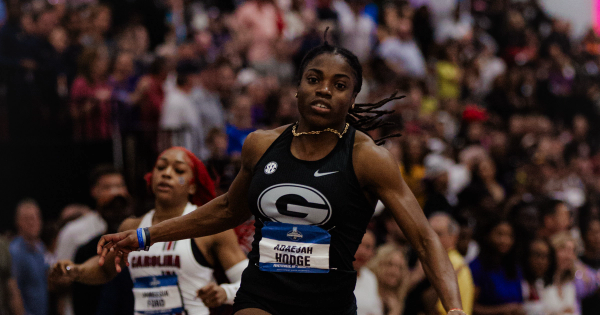
Much like the Adaejah Hodge situation, there’s a mountain of evidence that tells a compelling story, but ultimately it’s up to you to decide how you feel about it. Clevenger, through an attorney, insists he’s innocent of any wrongdoing, and you’re welcome to believe him—or not. It certainly seems like his competitors have strong feelings to the latter effect, given that at both podium ceremonies, the second- through eighth-place finishers departed the podium as soon as Clevenger’s name was announced and took a separate photo without him.
Now, to remove any semblance of a journalism costume… that’s totally rad. Track and field has a long and storied history of podium protests, from the big one on down through the decades. It’s an elegant and mature way to handle controversy and make your voice heard.
Let the race play out, as fairly and straightforwardly as the rulebook allows. Keep things civil at the finish line—sportsmanship isn’t totally dead; you don’t have to shake the hand of a rival you feel has done you wrong, but you shouldn’t punch them in the face either. However, if you don’t want to stand next to someone you don’t respect or wish to be associated with, for whatever reason you might have, it’s a free country! Get your trophy and get the hell out of there.
The DIII podium theatrics had all the hallmarks of a great sports moment. It was respectful and solemn but unambiguous. It didn’t put the meet officials or volunteers in a tough position, and it still gave everyone a moment to celebrate in a manner of their own choosing. Even the crotchetiest of old-timers must admit that the protest was quietly dignified and not an immature tantrum. Kudos to whoever came up with the idea.
The visual of Clevenger standing alone atop the podium, defiant in victory, could be viewed multiple ways, depending on your perspective. For Clevenger and his supporters, it symbolized the satisfying end to a long journey where it felt like the whole world was against you, and all you could rely on were your own two legs.
Or it could be interpreted a bit like the finale of VEEP (*spoiler alert* for a show that ended seven years ago), where Selina Meyer has finally achieved her life’s ambition, but she got to the Oval Office by selling out everyone around her along the way. The series ends with a quiet moment, where Meyer realizes she’s completely and utterly alone. The unspoken, final question hangs in the air: was it worth it?
Nothing about what precipitated the podium walk-off moment is exactly praise-worthy, but the way it was handled represents something kinda inspiring. The clock may be amoral, but the people subject to its impartial ticking aren’t. And in some ways, that’s the best thing about track and field: races evoke strong emotions in the athletes and fans alike, and our ability to collectively process and contextualize the mundane activity of running in circles is what makes the sport endlessly fascinating.
David Melly
Since David began contributing to CITIUS in 2018, he's done a little bit of everything, from podcast hosting to newsletter writing to race commentary. Currently, he coordinates the social media team and manages both the CITIUS MAG newsletter and The Lap Count, supplying hot takes and thoughtful analysis in both short- and long-form. Based on Boston, David breaks up his excessive screen time by training for marathons, crewing trail races, baking sweet desserts, and mixing strong cocktails.