By David Melly
May 6, 2026
It’s not every day that you see a packed stadium going absolutely out-of-its-mind bananas for track and field. But at last weekend’s World Relays, held for the first time in Gaborone, seemingly every fan in the 25,000-seat stadium was on their feet screaming and clapping every time a single Botswana athlete so much as set foot on the track to walk to the start line.
Let’s start by giving World Athletics some serious credit. The organization’s commitment to putting the “World” in “World Athletics” pays off in situations like these, where countries that have historically not been hot spots for professional track and field are given the opportunity to host big meets and celebrate the sport. Much like 2023 Worlds in Budapest or 2017 World XC in Kampala, the palpable excitement of the first-time host nation made the crowd a major character in the track and field narrative, lending some much-needed verve to an event that has become a bit of an afterthought on the global calendar in recent years.
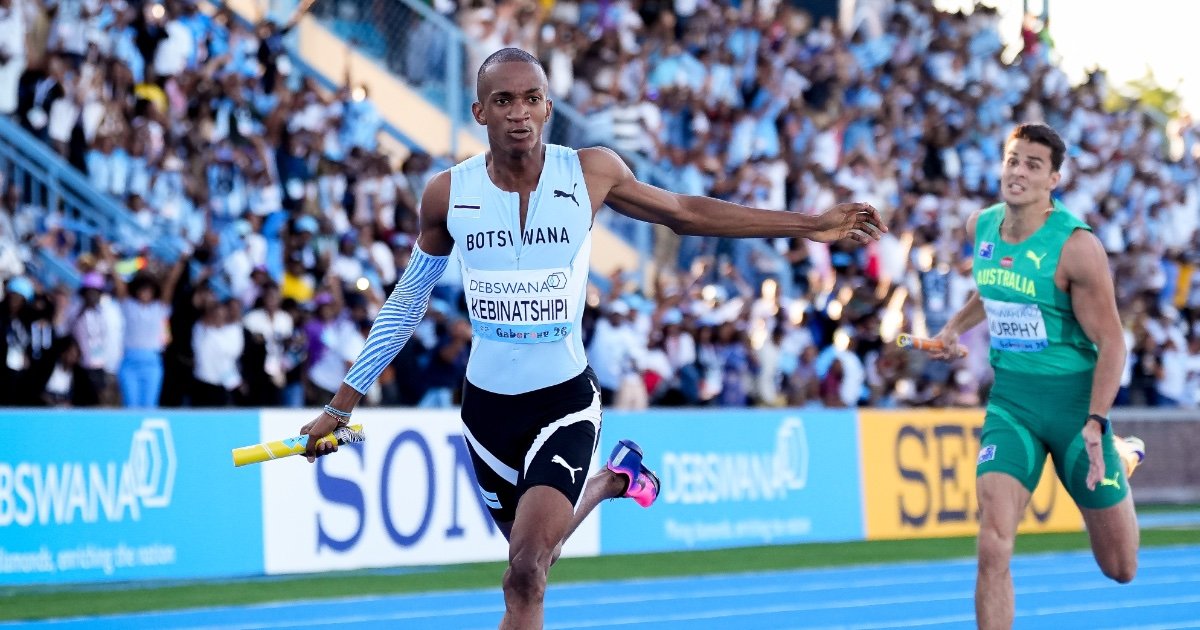
The biggest payoff for the home team came at the very end of the meet, of course, with the all-star Batswana quartet of Lee Eppie, Letsile Tebogo, Bayapo Ndori, and Collen Kebinatshipi winning a thriller of a 4x400m. (Editor’s note: That wasn’t a typo in the preceding sentence. “Botswanan” is an incorrect term for citizens of Botswana; the correct demonym is “Motswana” for individuals and “Batswana” for groups.) Questions about proper start lines and 3,000-odd feet of elevation aside, the results were nevertheless stunning: Botswana took the win in 2:54.47 ahead of South Africa (2:55.07) and Australia (2:55.20), the third, fifth, and sixth fastest marks ever run.
Pause: let’s consider that for a moment. Of all the all-star Team USA squads assembled over the years, only two—the 1993 team featuring Quincy Watts and Michael Johnson, and the 2024 Olympic team—have run faster than Australia did in Gaborone. Sure, there might be some weird altitude-acknowledging asterisks around the marks, but even still, it helps support the notion that carving out a little time for athletes to focus solely on relays is a worthwhile endeavor. Australia in general deserves a lot of credit for sending a team of 30 athletes halfway around the world, including stars like Torrie Lewis and Lachie Kennedy, and they were rewarded by making the final in three out of six events. Not too bad for a nation generally not considered a sprint powerhouse.
The Jamaicans weren’t messing around either, bringing in their big guns and coming home with two golds and a silver. With all due respect to the Team USA athletes who made the trip, no one on that roster was as big a name as Elaine Thompson-Herah or Ackeem Blake. Kishane Thompson and Oblique Seville, the top two finishers in last year’s World 100m final, were also initially named to the team, but withdrew before the meet. ETH continued to build hype around her triumphant return to the track in the women’s 4x100m with a virtuosic anchor leg, getting the baton well behind Canada and overhauling poor Donna Ntambue in a matter of steps before cruising to a 42.00 victory.
The strange experiment known as the “mixed 4x100m” continued to be… strange, with the rapid pace changes between legs causing all sorts of handoff issues. Nevertheless, Blake and the Clayton sisters powered Jamaica to sub-40 seconds in both the prelims and the final, becoming the first world record holders in the brand-new event. Unlike the mixed 4x400m, where handoffs are less critical to smooth execution and smaller countries have the chance to shine, this one feels like perhaps it’s just simply more trouble than it’s worth.
Overall, there was a bit of a reversal of fate in the American-Jamaican sprint rivalry. In recent years, the American women have been wildly successful on the world stage, but the men have struggled. This time in Gaborone, it was the opposite: the U.S. men won the 4x100m ahead of a hard-charging Akane Simbine of South Africa, but the Jamaicans failed to make the final entirely after finishing fourth in their heat on day 1. They returned to the repechage to book a spot in next year’s World Championships (more on that shortly), but didn’t have the chance to contend for medals. In the women’s race, however, the U.S. team didn’t even contest the repechage after finishing fourth in the heats, which means that the 3x defending champs will need to qualify for Beijing ‘27 some other way. Not a great look, particularly with 14 of the 15 fastest 100m American runners of 2025 sitting at home.
Before you scroll back up, you read that right: the meet being held in May 2026 is serving as a qualifier for the World Championship set for September 2027. In what world does that make sense? Particularly given the fact that participating countries are under no obligation to run the same athletes at both events, there isn’t the faintest logical argument for why 12 of the 16 spots should be determined 16 months in advance.
If World Athletics really wants to use their championship to entice teams to show up for World Relays, they actually haven’t gone far enough. The current setup is laughably illogical and does little to motivate the big nations to bring the big guns. Instead, they should hold the two events the same year, but require participating countries to declare and enter the same six athletes for both. You want a bonus gold medal, Noah or Sydney? Then you’re going to have to pick up a baton at least twice a year.
The meet broadcast itself also had its ups and downs. Compressing the finals into the last hour of the program made for a very exciting hour, but it also made the rest of the event feel like background noise. Relays are short, high-stakes, and exciting by nature, but with only six finals slated, it doesn’t quite feel like a full meet. The return of a DMR, 4x200m, or even—gasp!—a 4x800m could help pad out the program a bit.
All in all, this year’s World Relays did feel a bit like the unique medals themselves. Embedded at the center of this event is the spirit of something interesting, and perhaps truly special, but you’ve really gotta squint to see it. The challenge we haven’t quite figured out yet is the right placement and presentation to make this little gem really shine.gbb

David Melly
Since David began contributing to CITIUS in 2018, he's done a little bit of everything, from podcast hosting to newsletter writing to race commentary. Currently, he coordinates the social media team and manages both the CITIUS MAG newsletter and The Lap Count, supplying hot takes and thoughtful analysis in both short- and long-form. Based on Boston, David breaks up his excessive screen time by training for marathons, crewing trail races, baking sweet desserts, and mixing strong cocktails.