By Citius Mag Staff
March 12, 2026
By David Melly & Paul Hof-Mahoney
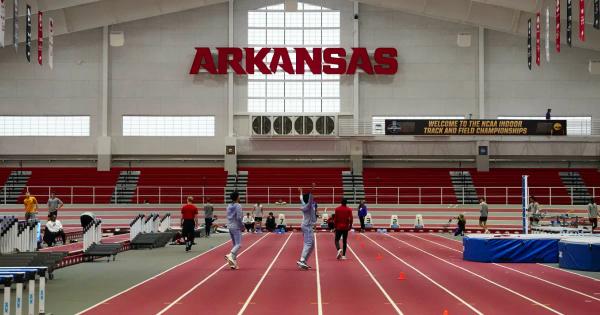
Buckle up: the most electrifying two-day meet in the world is coming up this weekend! After a few years on the East Coast, the NCAA Indoor Track and Field Championships return to Fayetteville, Arkansas, (and the Central time zone) for the 2026 edition. The best collegiate runners, jumpers, and throwers from around the country will bask in the benevolence of Big Chicken money as they flock to the Randal Tyson Track Center to fight for both team points and individual glory.
On the men’s side, it looks like the team battle is wide open. Defending champs USC has only four entrants, so they’re unlikely to pull it off again. Instead we’re likely to see a battle between a distance-heavy Oregon squad and a sprint-tilted Arkansas one. But neither team is leaps and bounds ahead of the rest, and a few surprises in the prelims could lead to Texas Tech or one of the SEC teams securing an upset. On the women’s side, the battle will be less “distance vs. sprints” and more “track vs. field,” as the Georgia Bulldogs look to dethrone #1 ranked Illinois, which has a whopping 14 qualifiers across the field events but zero on the track. Arkansas is probably the most balanced team on the women’s side, but if the BYU crew absolutely pops off, the Cougars could be a factor on distance scoring alone.
While the field events and multis kick off a bit earlier in the afternoon, the track action begins at 5pm Central Daylight Time on Friday, March 13th. On Saturday, the track finals kick off at 4pm CDT, and both days are available on ESPN+ (subscription required). You can find a full schedule, live results, and list of entries here.
Indoor NCAAs is full of ambitious doubles, tight turnarounds, and hefty team score swings within event groups. We’re breaking down all the action and key races to watch be event group below:
Women’s Sprints
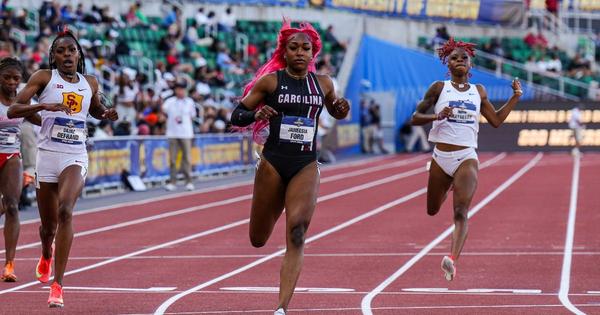
After years of dominating on the high school and junior levels, Georgia freshman Adaejah Hodge finally takes center stage at the NCAA level. Hodge is the fourth fastest seed in the 60m, where she finished fourth at SECs, but she’s probably the favorite in the 200m, where she’s the fastest entrant and SEC champ. Her 22.32 season’s best is over 2/10ths of a second ahead of former champs Indya Mayberry of TCU and South Carolina’s JaMeesia Ford, the other two major contenders in the single-lapper.
Dajaz Defrand, the defending 60m champ for USC, unfortunately false started at Big Tens last weekend, so we won’t know for sure where she stacks up against SEC champ Alicia Burnett of Ole Miss or Tarleton State’s Victoria Cameron, the two fastest seeds, both at 7.08. Defrand’s Trojan teammate Madison Whyte has been a force in the 200m in past years, but this time around she’s opting to run only the 400m, where she’s the top seed and Big Ten champ. After years of dominance, Arkansas isn’t looking likely to run the table in the 400m for once, as LSU’s Ella Onojuvwevwo is the only entrant besides Whyte under 51 seconds. Look out for potential team title implications here for Georgia, with two entrants in the top five seeds.
In the 60m hurdles, Kentucky’s Emmi Scales hasn’t lost to another collegian all season, and leads all entrants at 7.83. Right behind her though, defending champ Jaiya Covington of Texas A&M and last year’s runner-up Aaliyah McCormick could easily challenge for the win as well.

Audrey Allen / @audreyallen17
Men’s Sprints
The men’s 60m dash should be a barn-burner and one of the best events of the whole weekend, with the top four entrants having run under 6.50 this season and only 0.04 seconds separating them. At SECs, Auburn’s Kanyinsola Ajayi equalled the NCAA record of 6.45, but on the same weekend at the other end of Texas, Malachi Snow of Texas Tech won Big 12s in 6.46. Snow is also one of the top contenders in the 60m hurdles, and should he pull off the double, that could really swing the team race for Texas Tech.
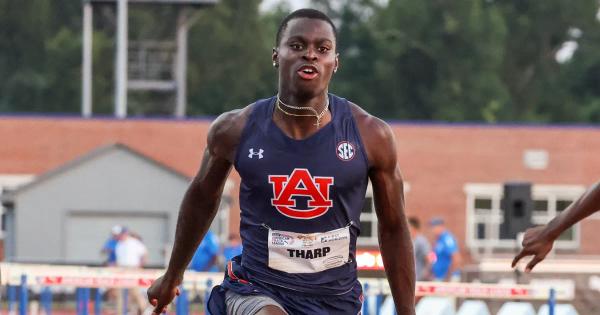
The high hurdles are also shaping up to be memorable, with Snow facing down Bradley Franklin, the NCAA leader for Samford at 7.41, and U.S. 110m hurdles champ Ja’Kobe Tharp, Ajayi’s Auburn teammate. Tharp is also the defending NCAA and SEC champ, so he’s probably the betting favorite.
There’s less 60m-200m overlap on the men’s side, where USC’s Garrett Kaalund gave the NCAA record a scare earlier this season with a 20.06 stunner at Big Tens. That was the fastest collegiate time in seven years, and he’s the fastest returner from both indoors and outdoors last year, so consider him your favorite. With Texas A&M’s Auhmad Robinson prioritizing just the 200m, the 400m is wide open. Georgia freshman Jonathan Simms leads all qualifiers at 44.62, but he ran that time way back in January and hasn’t won a race since, finishing third at SECs behind Alabama’s Samuel Ogazi and Arkansas’s Jordan Pierre. Ogazi is the defending outdoor champ, so he’s maybe a slight favorite there.

Kevin Morris / @kevmofoto
Women’s Distance
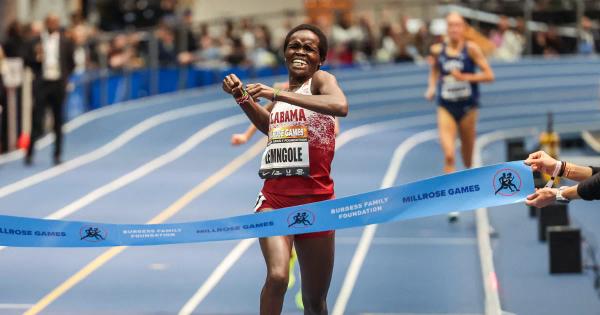
In the women’s distance events, all eyes are going to be on top dogs Jane Hedengren and Doris Lemngole as the BYU freshman and Alabama junior match back up for the first time since the Millrose Games. The NCAA XC 1-2 are both double entered in the 3000m and 5000m, and in both events, it would be a huge shock to see anyone else in the mix late. Lemngole took a surprise loss to West Virginia’s Ceili McCabe at last year’s 3000m, though, so anything can happen. And after a solo 15:02.52 victory at SECs, Arkansas’s Sydney Vaught follow-up performance in the 5000m will be hotly anticipated.
With the exception of a third-place run in the mile earlier this season, which isn’t exactly her wheelhouse, Lemngole hasn’t lost a distance race to NCAA competition since that 3000m last year. Make no mistake: as much as Hedengren is a generational talent, Lemngole remains the woman to beat until proven otherwise.
The mile will be a fascinating race, as five of the six fastest collegiate performers of all time are entered (and the sixth is Jane Hedengren). BYU’s Riley Chamberlain has shown tremendous championship chops in the past, most notably anchoring the Cougars to two NCAA titles in the DMR. Could this be her time to shine as an individual? She’ll have her work cut out for her in the form of a formidable Oregon duo, Silan Ayyildiz and Wilma Nielsen, as well as Oklahoma State’s Billah Jepkirui and NC State freshman Sadie Engelhardt.
2024 Olympian Juliette Whittaker will look for redemption after missing the 800m final entirely at last year’s indoor NCAAs, but with four other women entered with sub-two SBs, plus NCAA 1000m record holder Sophia Gorriaran of Harvard, it’ll be a tough fight. Earlier this season, Clemson’s Gladys Chepngetich became the first NCAA runner not named Athing Mu to break 1:59 indoors, but Whittaker took down Chepngetich at ACCs by a handy margin in a tactical race. Defending champ Makayla Paige of UNC only finished third in that race, but who knows what she has in store for Fayetteville.

Kevin Morris / @kevmofoto
Men’s Distance
One of the biggest surprises from last week’s entry list drop was somebody who wasn’t racing the 800m, NCAA record holder Colin Sahlman, who is sticking to the 3000m-DMR double for NAU. That’s great news for Penn State’s Handal Roban, the second-fastest collegian in history indoors, who enters as the only sub-1:45 seed ahead of Georgetown’s Tinoda Matsatsa (#2 at 1:45.12). Defending champ Matthew Erickson is back for the Oregon Ducks and will certainly be a threat in a tactical race, but the guy you shouldn’t sleep on is Texas A&M freshman Peter Narumbe, who’s only the tenth seed by time but hasn’t lost an 800m all season.
Another guy who’s opting to focus on one open event is Gary Martin. The Virginia senior is back to defend his team’s title in the DMR, but he’s opting to run the mile instead of the 3000m, where he finished second last year behind Ethan Strand. The mile is relatively open this year, so this could be his chance to finally pick up an individual title after years of All-American finishes.
Notable doublers include Virginia Tech’s George Couttie, entered in both the mile and 3000m, and two-time NCAA champ for New Mexico Habtom Samuel, who’s using his half marathon strength to take on the 3000m and 5000m. Villanova’s Marco Langon will have two different opportunities to dive at the line, as he’s also running both distance races. Talented BYU freshman Tayvon Kitchen is doubling 3000m/5000m just like his fellow Cougar freshman Jane Hedengren, although a pair of scoring finishes would probably be a more realistic goal for him.

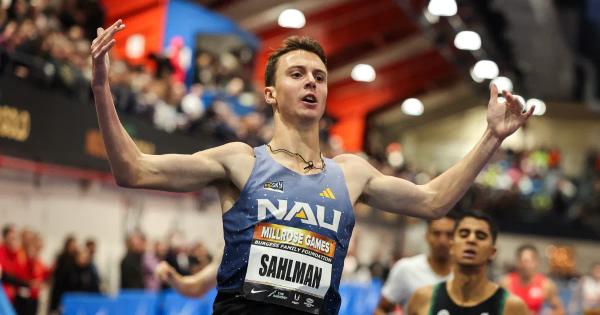
Kevin Morris / @kevmofoto
Women’s Jumps
This event group will prove highly critical in Illinois’ team title ambitions, as they have eight jumpers entered, covering every event. Rose Yeboah and Sophia Beckmon claimed Big Ten titles in the high and long jumps two weeks ago, and a similar placement this weekend would go a long way for the Illini. Yeboah will duel Texas Tech’s Temitope Adeshina, the national leader in the high jump, while Beckmon holds a 16cm advantage over the field in the long jump.
Washington’s Hana Moll will be flying solo in Arkansas, as her sister and defending national indoor champ Amanda failed to qualify for Nationals in her only competition of the season. Moll’s 4.88-meter clearance from the UW Invite in late January paces the NCAA by 15cm, but the South Dakota duo of Marleen Mülla and Anna Willis will be ready to pounce should she falter.
Clemson’s Shantae Foreman is the only woman over 14m this season in the triple jump thanks to her 14.17-meter effort in January. She has looked slightly more human across her last two competitions, however, leaving the door open for somebody like Rūta Lasmane of Texas Tech or Nebraska’s Rhianna Phipps.
Men’s Jumps
While the most eye-catching aspect of this slate of events may be that Tennessee qualified five men in the pole vault, the most exciting competition is sure to be the long jump. Four men—Oklahoma’s Kennedy Stringfellow, Princeton’s Greg Foster, Ohio State’s DJ Fillmore, and Kelsey Daniel of Texas—have jumped 8.20m or better this year, shaping up for an epic clash if the quartet is in its best form.
Georgia’s Kimani Jack made an emphatic statement with his SEC title win in 2.28m, snatching the national lead two weeks before the season’s final meet. Two pairs of teammates sit just behind him at 2.25m: Kansas State’s Alan Hanna and Devin Loudermilk and Oklahoma’s Kyren Washington and Tyson Ritz. Despite sitting on the outside of the upper echelon of competitors, don’t overlook Arvesta Troupe, the reigning NCAA Outdoor champ for Ole Miss.
Women’s Throws
There is a breakaway quintet in the women’s weight throw this season. Minnesota’s Anthonett Nabwe, Texas’s Giavonna Meeks, Illinois’s Phethisang Makhethe and Jordan Koskondy, and Ole Miss’s Akoama Odeluge have combined for the 22 best marks in the NCAA this season. All five women met at the Tyson Invitational last month, with Nabwe coming out on top in the national-leading mark of 24.67m. However, Nabwe was runner-up at Big Tens to Makhethe and came up nearly a meter-and-a-half short of Meeks’s 24.44-meter toss to win the SEC title. If the Golden Gopher can exorcise her NCAA Indoor demons (11th while being seeded first in 2025, 16th as the fourth seed in 2024), she should hold the advantage in this one. It’s also worth noting that the defending champion, Wisconsin’s Taylor Kesner, is in the field once again after landing a PB by well over a meter to win last year.
The only thing in the way of a second-straight NCAA Indoor shot title for Nebraska’s Axelina Johansson is… essentially nothing. The Swede set the indoor collegiate record in December with a mammoth effort of 19.72m, which she backed up with a Big Ten title win at 19.47m, the fourth-best performance in collegiate history. Auburn’s Megan Hague has been making a strong run to give Johansson some competition though, bringing her PB from 17.72m to 18.89m in the span of a month. Also keep an eye out for Penn freshman Jessica Oji and Johansson’s teammate Miné de Klerk, the two best throwers in African history after going 18.50m and 18.48m, respectively, over conference weekend.
Men’s Throws
The title races in the men’s throwing events probably won’t be the most exciting storylines of the meet, but the battles behind the two favorites should provide some fireworks. Iowa’s Ryan Johnson and Ole Miss’s Tarik Robinson-O’Hagan each hold their respective national leads by over a meter, with Johnson breaking the 11-year-old collegiate record in the weight with a 25.66-meter heave at Big Tens.
The Hawkeye owns the 13 best throws in the nation this season, while Robinson-O’Hagan—the two-time defending indoor national champion in the shot put—has produced the 17 best throws in the country, highlighted by his PB of 21.18m from January.
Air Force’s Texas Tanner is the only other man over 24 meters in the weight this season, but he threw his 24.18-meter PB back in December. Since then, his best mark is a still-imposing-but-slightly-less-impressive 23.37m. There’s a bit of a logjam behind Tanner on the toplists, as Virginia’s Jeremiah Nubbe, Robinson-O’Hagan, and Kansas State’s Gary Moore are separated by just 26cm. Nubbe will be joined in Fayetteville by teammates Nikolaos Polychroniou and Keyandre Davis, both of whom have also cracked 23m this winter.
Five other men have joined Robinson-O’Hagan over the 20-meter line this season, with Florida’s Jarno van Daalen and Mississippi State’s Roury McCloyen breaking that barrier for the first time at SECs. Keep an eye on Quentin Peterson out of Gardner-Webb after the senior went 20.10m to win the Big South title, tacking well over a meter onto his PB with just one throw.

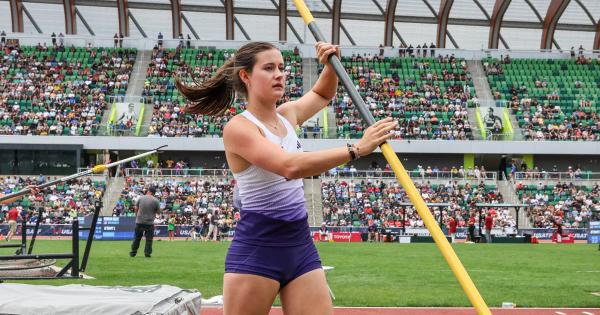
Kevin Morris / @kevmofoto
Women’s Relays
There’s a strong possibility that both 2025 champs double back in the relays, as Arkansas enters with the top time in the 4x400m and BYU tops all entrants in the DMR. With newly-minted NCAA record holder Riley Chamberlain on anchor, the Cougars likely expect to be in the driver’s seat once again, but Oregon’s 1-2 punch of Wilma Nielsen and Silan Ayyildiz could make a big difference if the pace is honest from the gun.
Arkansas is in a great spot to win its fourth 4x400m title in five years (which would be five had the Razorbacks not been DQed in 2024), but this may be their toughest challenge in recent memory as both South Carolina and Georgia field strong teams. Arkansas defended its home turf at SECs, but just 0.07 seconds separated the three teams in the end, so it wasn’t exactly a cakewalk. The Razorbacks may be slightly fresher than their rivals, but sometimes getting in a rhythm at NCAAs can be more beneficial than taking extra rest.

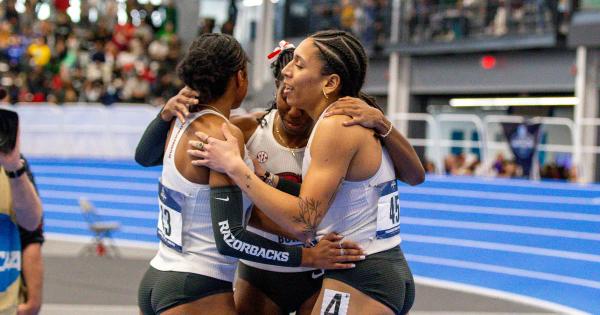
Jan Figueroa / @janfigueroa07
Men’s Relays
Unlike the women, a double-repeat is looking highly unlikely in the relays. 2025 4x400m champs Georgia are only the eighth seed and got beaten fairly decisively by Arkansas at SECs. South Carolina is the top entrant, but only finished fifth at SECs. If you’re tired of Southeastern sprint dominance, here’s some bad news: eight of the twelve entrants, and all five of the top seeds, come from the same conference.
The Hoos of Virginia have a better chance to defend in the DMR, thanks to the return of Gary Martin, but they’ll have an uphill battle as a number of teams have run out of their minds already this season. If Oregon can stay out of their own way, they could take the win with any combination of Elliott Cook, Simeon Birnbaum, Thomas Palfrey, and Matthew Erickson. If you’re inclined to bet on fresh legs, however, #1 seed Michigan may be your horse as they only have one entrant in an open event, Trent McFarland, although he’ll likely be running the anchor a few hours after the mile prelim.
Thanks to the Ducks and the Hogs, among others, the relays could have big team-title implications. As it so often does with NCAAs, the winner could be decided on the final leg of the final event of the final day—what’s better than that?

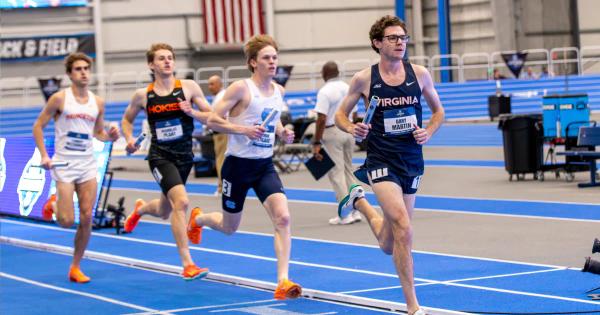
Jan Figueroa / @janfigueroa

Citius Mag Staff