By Rachel DaDamio
May 6, 2026
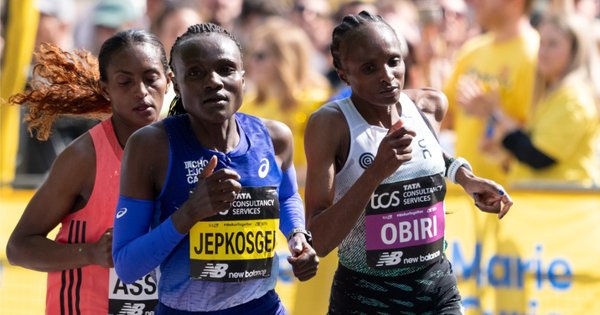
At the front of the pack in this year’s Boston Marathon, John Korir broke a 15-year-old course record, running a blazing 2:01:52. On the women’s side, Sharon Lokedi ran 2:18:51, the second fastest time ever by a woman on the course (she set the course record in 2025 with 2:17:22). The top Americans, Zouhair Talbi and Jess McClain, broke the men’s and women’s American course records in 2:03:45 and 2:20:49, respectively. In other words, it was a historic day in Boston for the professional field.
This monumental Boston marathon extended beyond the pros. The Fast Women Instagram account posted an eye-catching chart showing a steep jump in the number of women breaking 3 hours at Boston, and it made me want to dig into the full results.
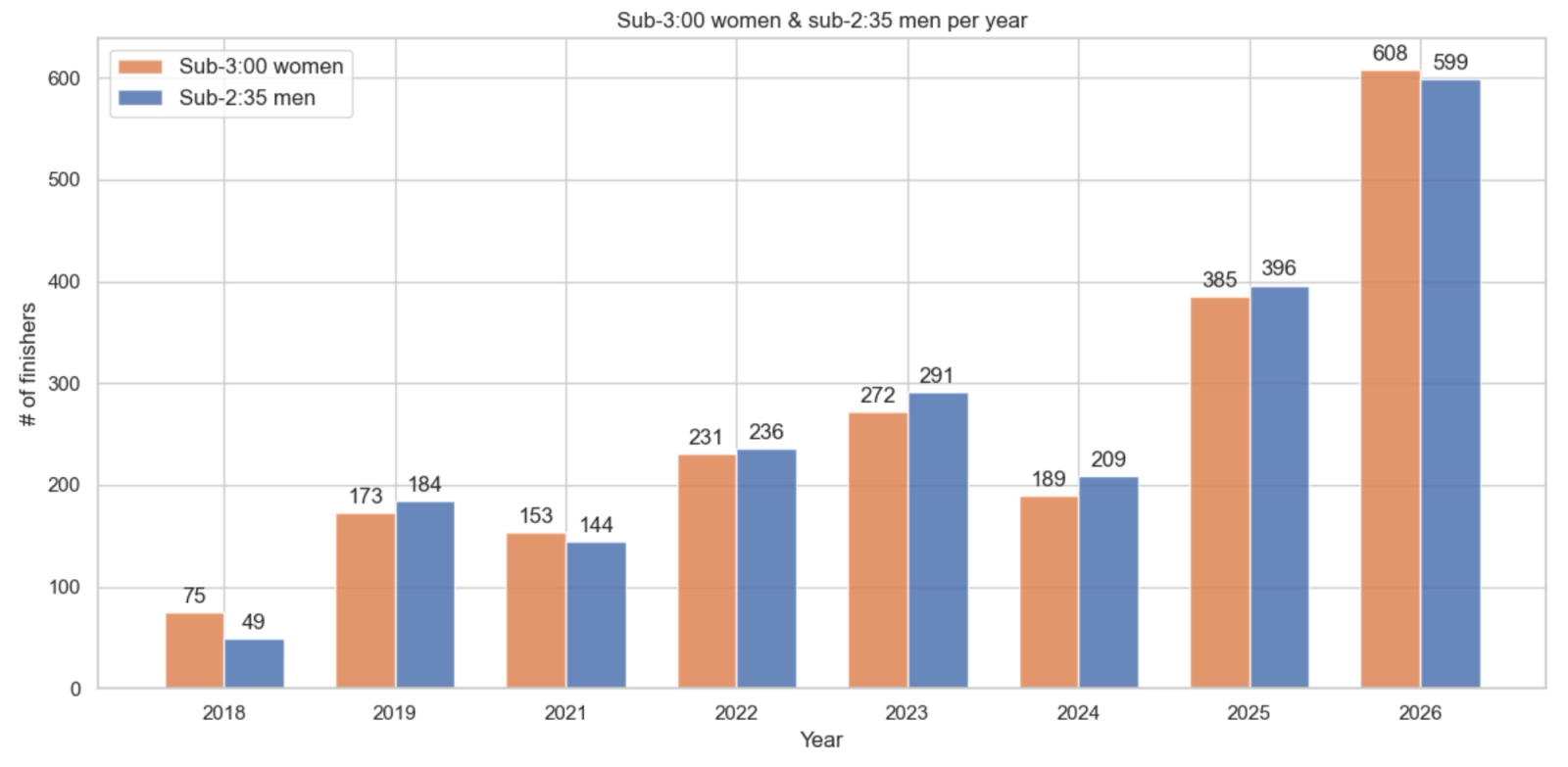
First, I wanted to determine the men’s equivalent to a women’s sub-3, and see if the time remained consistent. I matched each year’s last sub-3 woman with the man who finished in the same overall rank. That man’s time is the men’s equivalent of sub-3 for that year. This time has remained stable, around 2:35, for the past eight years.

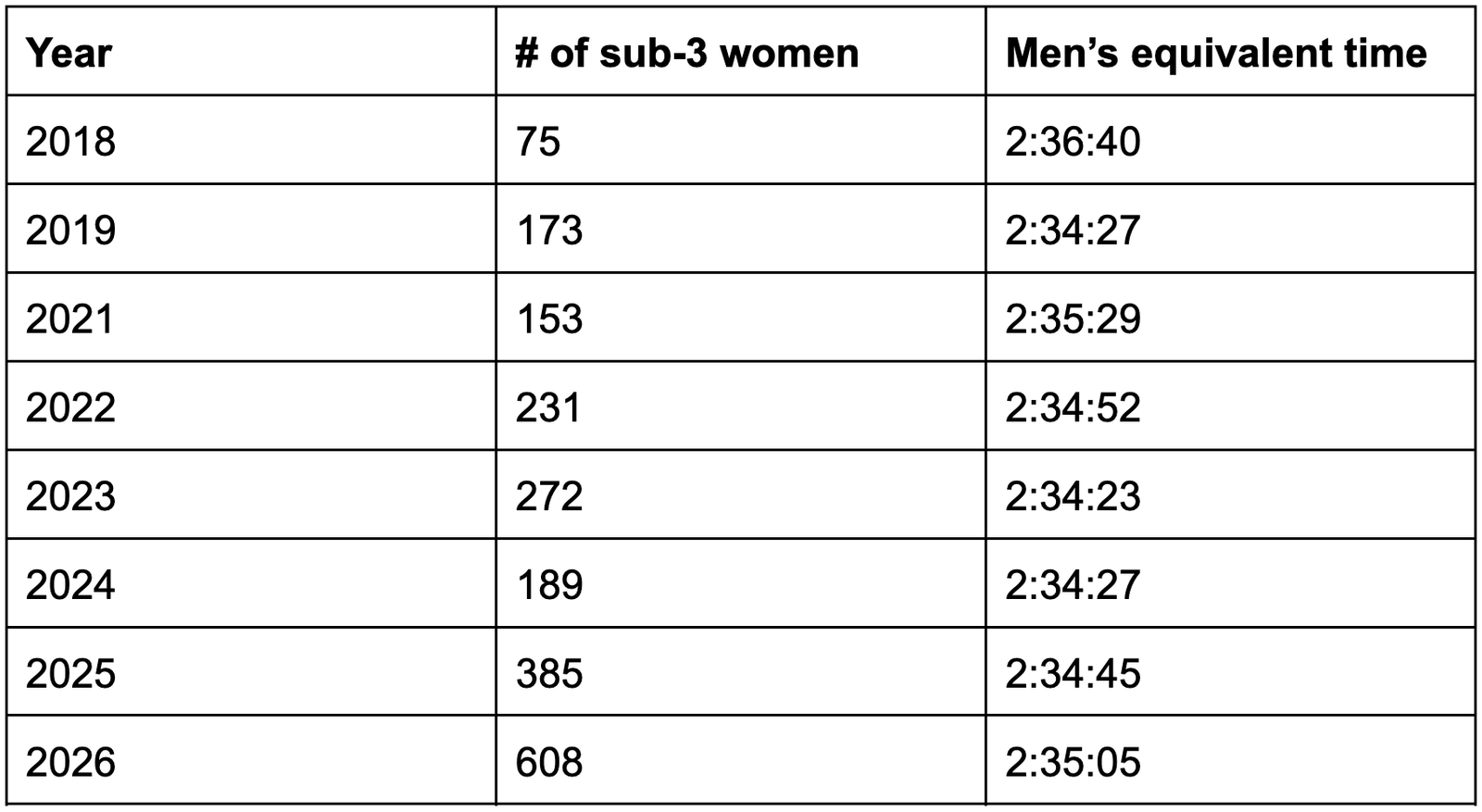
The stability of the men’s equivalent time suggests men have benefited from the same performance tailwinds – more advanced super shoes, innovations in fueling, and better training – that pushed more women under 3 hours.

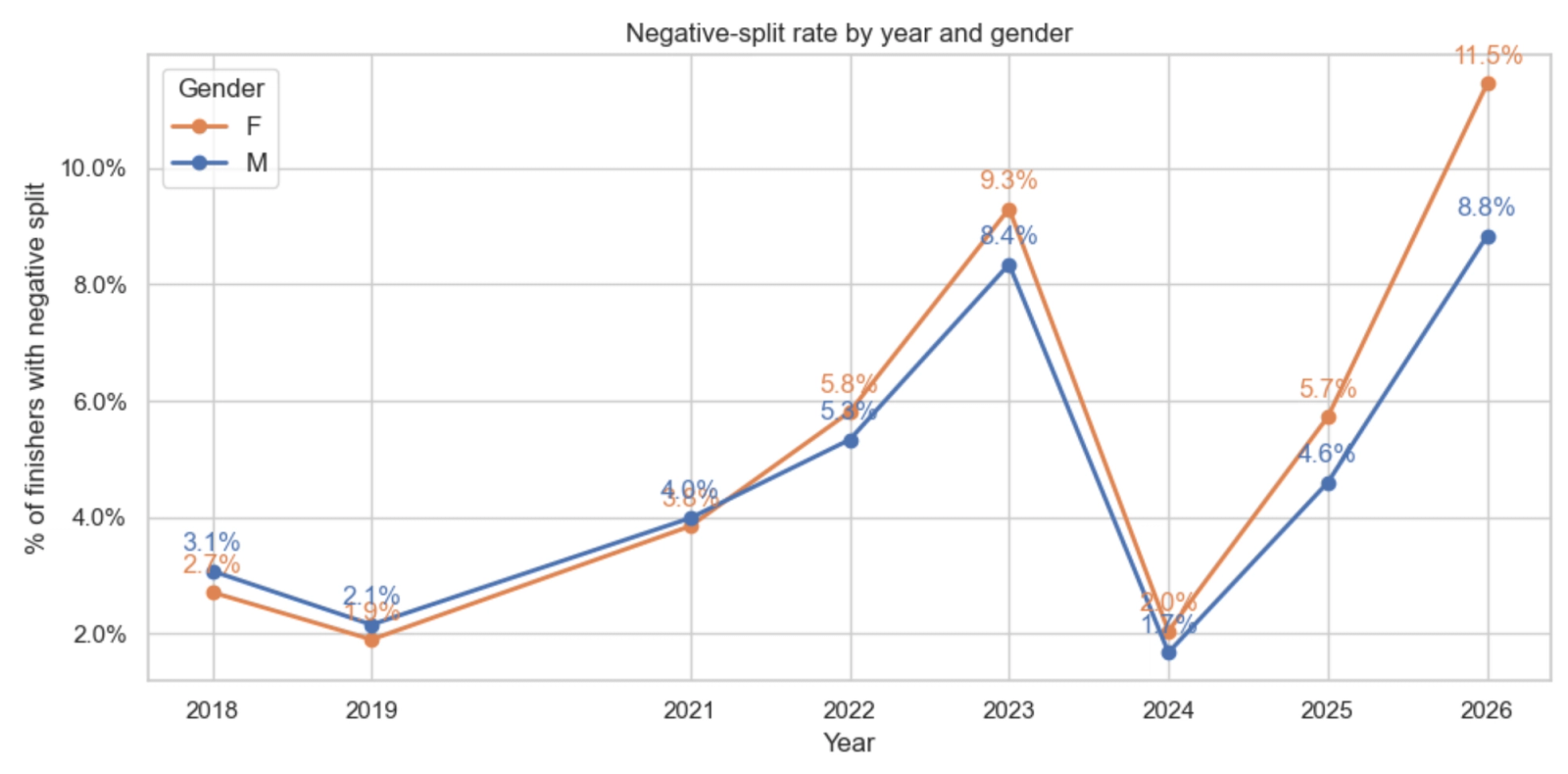
Beyond hitting time barriers, runners also executed better on the course. An aggressive downhill start paired with the Newton Hills makes a negative split in Boston just as impressive as a sub-3 (or a sub-2:35). Negative splitting in Boston is rare – in the past eight years, just over 5% of runners ran a negative split (defined here as running the second half at least 30 seconds faster than the first half). 2026 was a historic year for negative splitting as well, with 10% of runners negative splitting, 11.3% of women and 8.8% of men. Over the past five years, women have been slightly more likely to negative split compared to their male competitors.

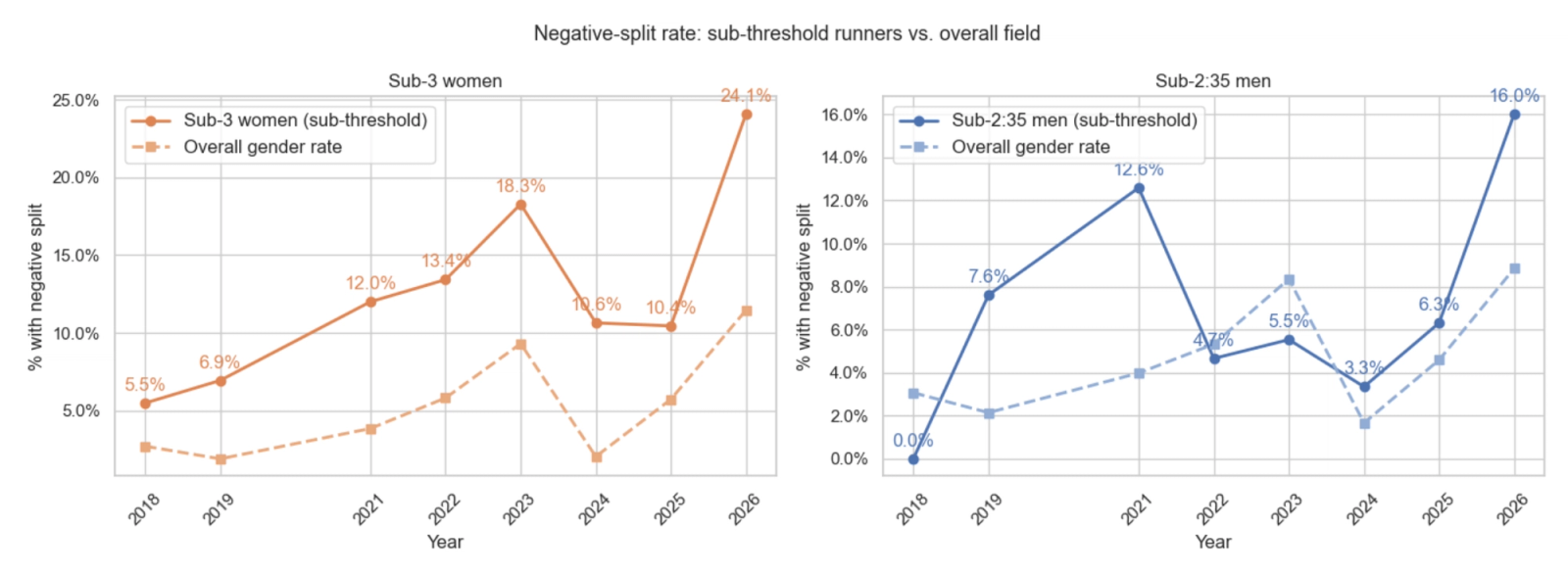
At the front of the pack, almost one in four sub-3 women ran a negative split. Sub-2:35 men negative split less often than sub-3 women, but still at a historic rate: 16% vs their previous record of 12.6% in 2021.

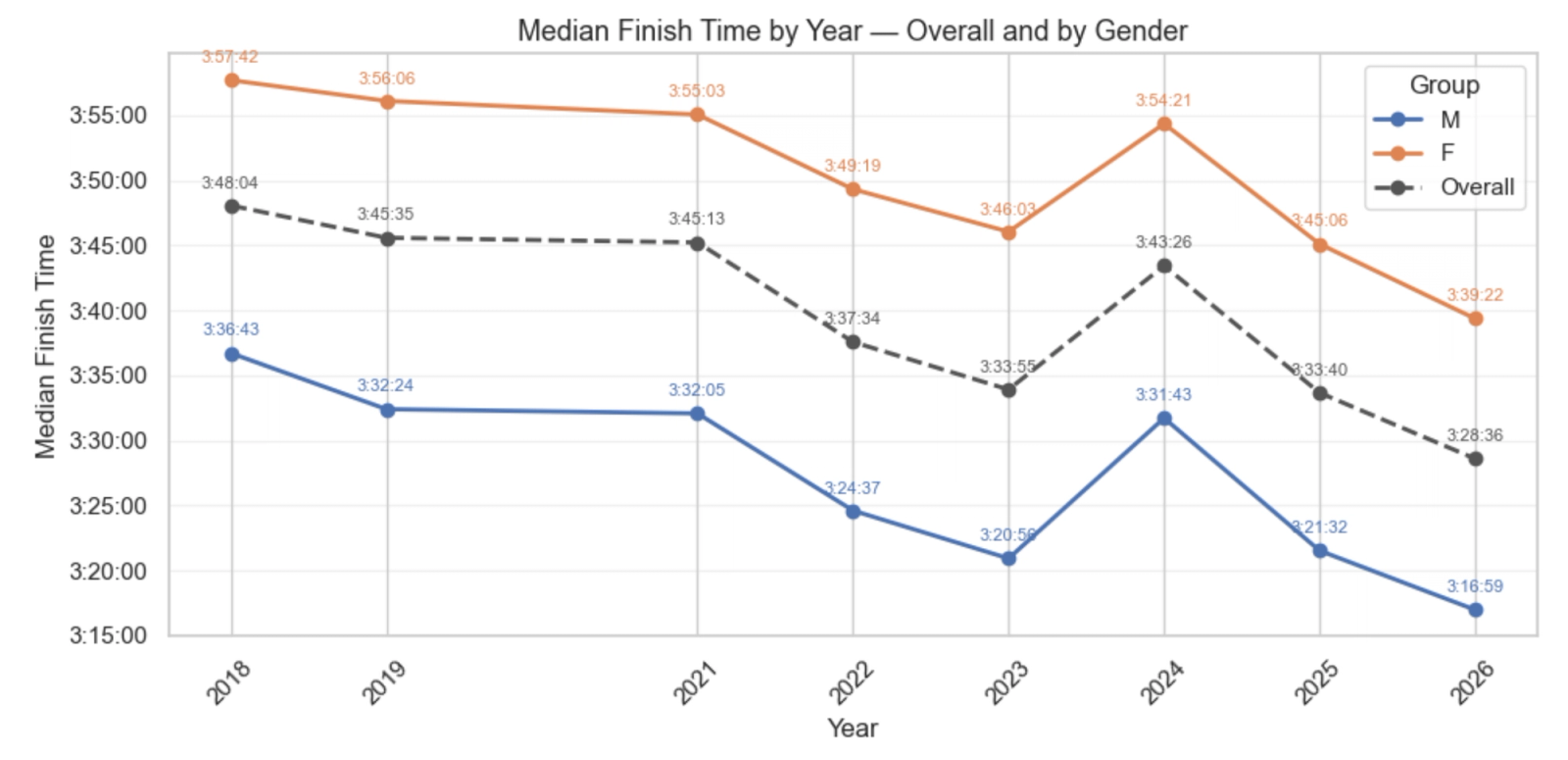
The field in this year’s Boston Marathon was as fast as it's ever been. The median time decreased 4.5 minutes for men and nearly 6 minutes for women compared to last year, and by nearly 20 minutes overall compared to 2018. Weather explains part of it. 2026 had near-ideal conditions, while 2024 was unseasonably hot and 2018 was characterized by cold rain and headwinds. You can see those anomalies reflected in the median times, but otherwise the results are trending faster.

Boston isn’t just getting quicker at the front. The whole field is moving up, and they’re pacing it smarter to get there.
Listen to the full breakdown on this week's episode of Getting Chicked.

Rachel DaDamio
Rachel DaDamio ran at the University of Notre Dame and moved to Chicago after graduating to work as a data scientist, where she’s also training for a fall marathon.