By David Melly
February 18, 2026
Did anybody else feel like there were a lot of track meets this weekend? From Boston to Birmingham, Fayetteville to the Fast Track, it seemed like every indoor oval in the Northern Hemisphere was booked and busy. If you weren’t able to convince your Valentine that a trip to the “short track” is the perfect date, you were forced to sit on your phone, constantly refreshing a menagerie of live results tabs for hours on end—an equally romantic way to spend the weekend.
Where to start… Cole Hocker’s American record? Keely Hodgkinson’s 1:56? Elle St. Pierre and her parade of record-breaking collegians?
Here’s the thing: the plethora of racing options this weekend offered a rich bounty of storylines, but that’s also kind of the problem. Let’s take the UK Indoor Championships, for example. Birmingham played host once again to the British national meet, and in theory, that should’ve been the highlight of the whole weekend. Josh Kerr! Georgia Hunter Bell! Matthew Hudson-Smith! …were all not there. In the first two cases, both Kerr and Hunter Bell were slated to compete, but granted last-minute medical exemptions by UK Athletics.
Because the British governing body doesn’t have a hard-and-fast World trials system, big stars facing small setbacks in training are able to still secure their spots at World Indoors without showing up and racing domestically. We don’t know the extent of their injuries, and we would never begrudge athletes’ desire to get and stay healthy… but it’s going to be a little annoying if Hunter Bell shows up in Lievin tomorrow, five days after the national championship, and crushes a sub-four 1500m.
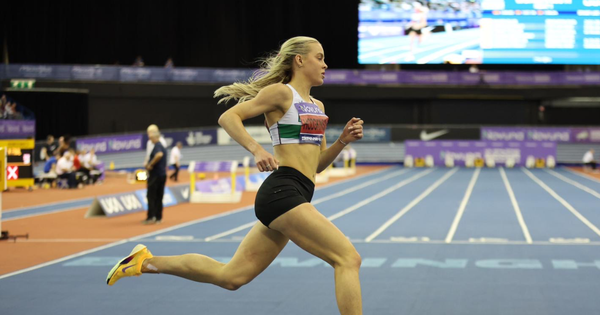
Hunter Bell’s training partner, Keely Hodgkinson, did show up and race. Hodgkinson, who’s seemingly never once in her career needed to bust the rust, opened up her 2026 season by shattering her own national record in the 800m in the heats, clocking a solo 1:56.33 effort to land at #3 all-time indoors. Jolanda Ceplak’s 1:55.82 world indoor record from 2002 is officially living on borrowed time… but it’ll live at least a little longer, because Hodgkinson skipped out on the final, presumably to prepare for Lievin as well. That means that she’s still yet to face the #2 Brit this year, Isabelle Boffey, and paradoxically is the fastest 800m runner on the weekend but not the national champ. Shoutout to Boffey for actually starting—and winning—the final.
Let’s not dwell on the negative. Many of the biggest British athletics stars did show up and run through the rounds. Huge kudos in particular to Dina Asher-Smith, who, despite being based in Texas for training, made the trip to take on Amy Hunt in the 60m and come out victorious, 7.05 to 7.15. Asher-Smith’s now won New Balance, Millrose, and her national championships all in the last month, exactly the sort of schedule you’d expect of a top sprinter, but somehow more the exception than the rule. Thanks Dina!
Major not-kudos, on the other hand, to the second-fastest Brit of all time over 60 meters, Daryll Neita, who opted to run at the Tyson Invitational in Fayetteville, Arkansas instead of racing Asher-Smith and Hunt head-to-head in Birmingham. There’s no other way to say it—that’s lame!
The UK champs’ loss was the Tyson Invitational’s gain, however: those chicken-mongers know how to put on a rockin’ meet. Arkansas alum Jordan Anthony, last year’s NCAA champ over 60 meters, took down Trayvon Bromell and a pair of speedy Tennessee Volunteers with a blazing 6.43 victory, the T-10th fastest mark in history. Noah Lyles, who doesn’t often run a long indoor season, clocked his first indoor 200m in five years and got the win and an indoor PB of 20.56. Another beloved Arkansas alum, Britton Wilson, showed she’s back fully healthy and fit with a 50.66 victory over training partner and fellow former Razorback Nickisha Pryce. A bunch of pros taking over a collegiate home meet isn’t exactly ideal, but it’s still great to see them racing hard, and racing good competition.
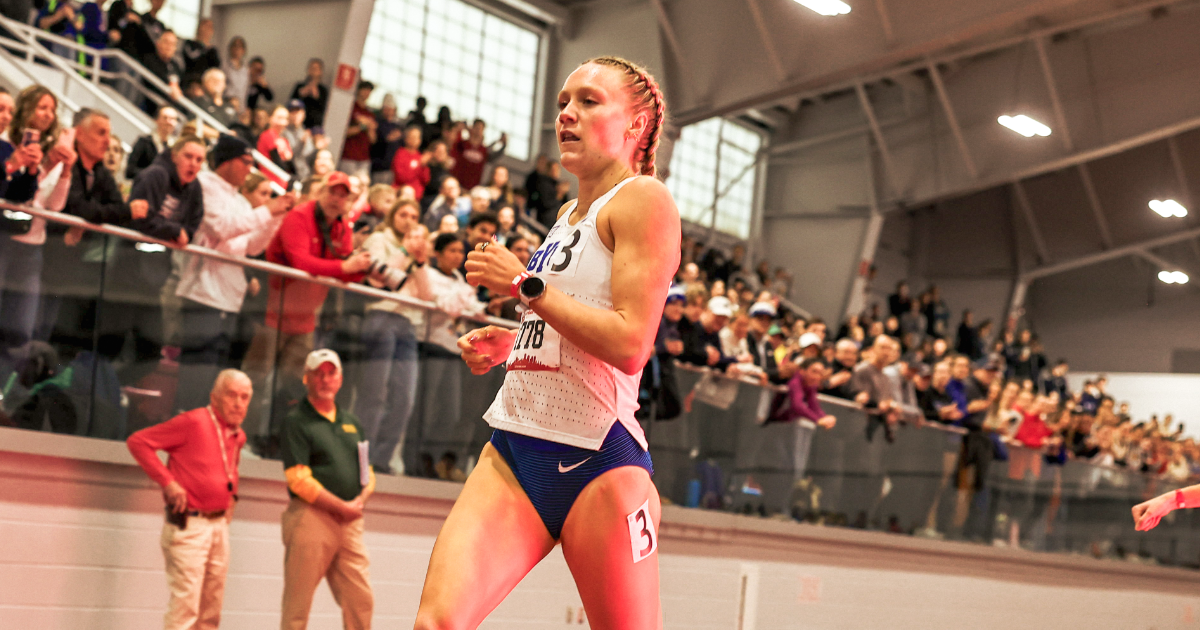
The collegians themselves are fully in the thick of it, with Tyson and the BU Valentine Invite representing, for many, the last big opportunity to drop a fast time before shifting into the championship phase of the season. Behind Elle St. Pierre’s 4:17.83 mile in Boston was an epic NCAA battle, as three women got under the old collegiate record. Riley Chamberlain came damn close to clocking the first ever sub-4:20 in the NCAA, but Oregon’s Wilma Nielsen deserves a lot of credit for trying to go with St. Pierre and paying the price (to the tune of a 35-second final lap… oof. But ultimately Chamberlain timed her kick just right to put the new collegiate record in BYU hands. Behind them, Jane Hedengren became the fastest college freshman ever at 4:22.22, which also would’ve been a collegiate record had she not finished fourth.
The one stud that was missing was NC State’s Sadie Engelhardt, who opted to race closer to campus at the JDL Fast Track in Winston-Salem, and ran a 4:23.84. That would’ve been good for “fastest freshman ever” status if she’d only run it a few hours earlier! You can hardly accuse Sadie of dodging, however, as she was stepping up to race pros like Emily MacKay and Maggi Congdon without leaving the state, a totally understandable meet to put on the calendar.
Speaking of fast middle-distance runners with poor timing, you’ve gotta feel for Penn State’s Handal Roban, who’s putting together an 800m campaign for the ages but keeps getting overshadowed. He ran 1:44.73 at JDL, which would’ve broken Paul Ereng’s collegiate record had Colin Sahlman not done so earlier this month at Millrose. And he had to further suffer the indignity of losing to a high schooler! To be fair, he’s the fastest high schooler of all time in 17-year-old Cooper Lutkenhaus, who blitzed an astonishing 1:44.03 to set the world junior record and land at #6 all-time on the SENIOR indoor list. A totally honorable L for Roban to take, because Lutkenhaus is proving over and over that he’s more of a generational talent than a flash in the pan.
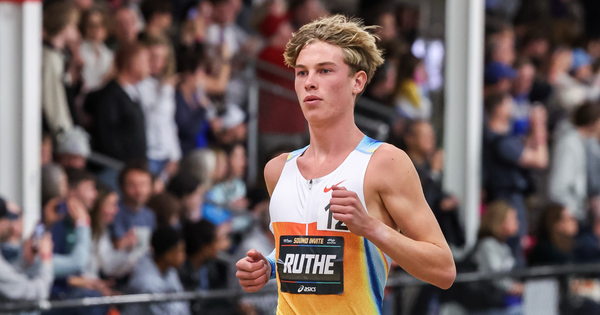
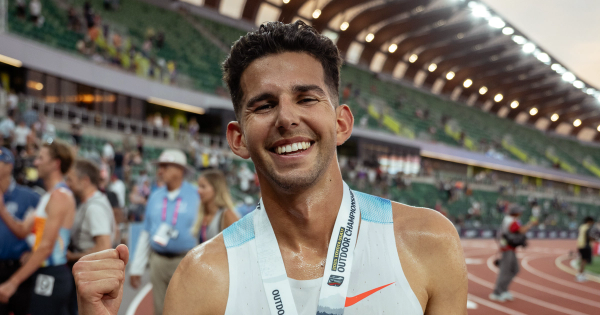
Of course, that wasn’t even the best intergenerational battle of the afternoon. Three weeks ago, it would seem absurd to imagine that Cole Hocker’s biggest threat at JDL would be a 16-year-old Kiwi, but Sam Ruthe’s 3:48 in Boston put him firmly in the conversation against Old Man Hocker, age: 24. But while Ruthe is undoubtedly a prodigy with boundless potential, he’s not yet a world-beater, whereas and more it’s seeming like Hocker-plus-healthy-training is a pretty invincible combo. Hocker didn’t just run 3:45.94 to break Yared Nuguse’s American record one week after its first birthday; he did so by winding up the field from the front and tearing it apart, closing his last 400m in 54.82 to expand his lead from 0.2 seconds to 4.5 seconds.
(Speaking of Nuguse and lethal kicks, Nico Young continues to show serious mid-distance wheels by beating Nuguse in the 3000m, 7:33.32 to 7:33.78. Young is going to be a problem in the 5000m this year.)
In years past, Hocker has intermittently caught flak for prioritizing small time trials over big races during the regular season. He’s also been viewed as a guy who will win you a medal in August but won’t be a factor in February. All that seems to be changing, and fast, with Hocker on his fourth straight win of 2026, running fast times with real competition. In 2025, the 1500m felt very in flux with the likes of Josh Kerr and Jakob Ingebrigtsen battling injuries, opening the door for guys like Isaac Nader. But if this version of Hocker is what we’ll get outdoors, the “no repeat champs” streak in the 1500m could come to an end quite soon.
Unless you’re a real freak who just loves paying streaming services, last weekend probably felt a little too diffuse. The common theme, however, was that the best races tended to be the ones where the biggest names toed the same starting line. This isn’t a new issue. In fact, it’s arguably one of the longest-running themes in the five-year history of this newsletter. There’s no one solution; fixing the track and field calendar would require a lot of different parties working together to make some tough decisions, and would likely make a few enemies. At the very least, we as fans can be discerning consumers, cheering loudest for the races with the best stakes and the athletes least afraid to take them on.
David Melly
Since David began contributing to CITIUS in 2018, he's done a little bit of everything, from podcast hosting to newsletter writing to race commentary. Currently, he coordinates the social media team and manages both the CITIUS MAG newsletter and The Lap Count, supplying hot takes and thoughtful analysis in both short- and long-form. Based on Boston, David breaks up his excessive screen time by training for marathons, crewing trail races, baking sweet desserts, and mixing strong cocktails.