By Citius Mag Staff
May 26, 2026
By Chris Chavez & Preet Majithia
World Athletics has released the qualifying standards and qualifying system for the World Athletics Championships Beijing 2027, which is a continuation of its hybrid model that combines entry standards with world rankings. However, those rankings now carry more weight than ever before.
Here’s everything you need to know:
Qualifying Window
The qualifying window for 2027’s Worlds—which will run from September 11th–19th—is:
- Marathon: November 3rd, 2025 to May 2nd, 2027
- 10,000m and Race Walks: February 23rd, 2026 to August 22nd, 2027
- All other events: August 23rd, 2026 to August 22nd 2027
The first big meets in the qualifying window will be the Silesia and Zurich Diamond Leagues, the Diamond League final in Brussels, then World Ultimate Championships, and ATHLOS to round out the 2026 season.
Wild Cards
Each country can have up to three athletes in each event, or four with a Wild Card, which will be awarded to the following athletes:
- Defending 2025 World champions
- Winners at the 2026 World Ultimate Championship
- Winners of the 2026 World Race Walking Tour and World Combined Events Tour
- Leading hammer performers on the 2026 Continental Tour
- Winners of the 2027 Wanda Diamond League
If two or more athletes from the same country would qualify via a Wild Card in the same event, only one of them can be entered with a Wild Card.
This is new since we’ve never had an Ultimate champion wild card before. Cordell Tinch won the 110 hurdles in Tokyo, but say Freddie Crittenden wins the World Ultimate Championships—USATF will have to determine selection priority for those two athletes before the 2027 US Championships. The only country likely to have two athletes with wild cards in the same event is Team USA. Kenya might also have an odd case in some of the women’s distance events but this seems like a problem for another day—but one we may have to think about more seriously after the World Ultimate Championships.
Qualifying Routes
Other than the Wild Cards, the aim is for 40% of entries to be allocated by qualifying standard, and 60% by way of the world rankings (in comparison to WA’s goal of 50% for each at the Tokyo World Championships).
The Area Champions (i.e. from continental championships) can also result in qualifiers if there are no other athletes qualified from that area via the other qualifying routes
5000m and 10,000m athletes can also run road races for qualifying standards or world rankings (but controversially, for women, mixed races will not count).
The old route of qualifying for the 10,000m via the World Cross Country Tour has been eliminated for now, which makes sense. In general it did not serve the intended purpose of incentivizing more top athletes to race cross country, and resulted in several athletes qualifying for the 10,000m over the last few years who were not competitive in a global 10,000m final.
Qualifying Standards
The qualifying standards are as follows:

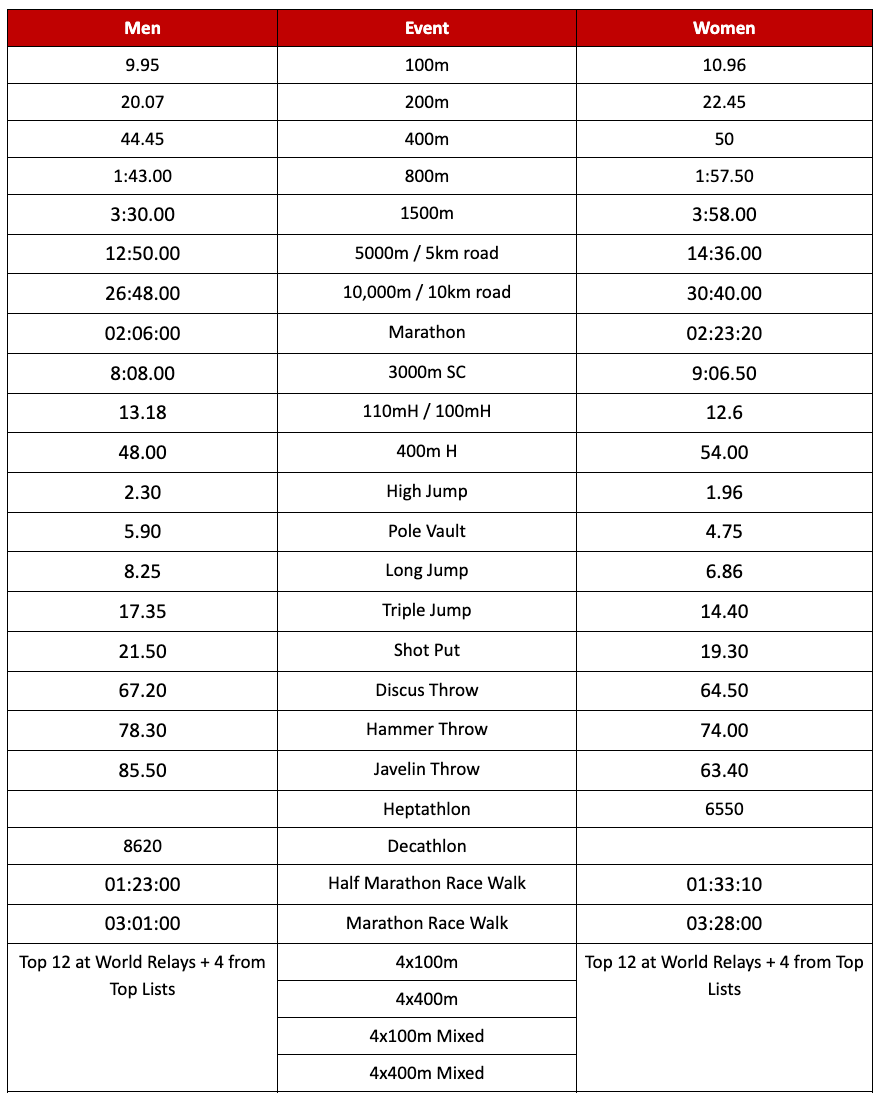
The qualifying standards for every event (other than the women’s 10,000m) have gotten loftier. This comes as little surprise, as World Athletics has been stating for a number of years that they intend to continue increasing the weighting of world rankings for purposes of qualifying for global championships.
Some of these standards look absolutely bonkers on paper (like 1:43 for the men’s 800!). But the reality is that only a very top tier of athletes will hit the standard in a single race, which is exactly what World Athletics wants.
We aren’t ringing the alarm that the United States won’t be able to field a team of three in most events. But the numbers are striking. Only three American men have ever run the 5000m standard now—12:50—but all three are still competing. With the men’s 10,000m at 26:48, only two Americans have ever run that, one of whom is still competing on the track. In the case of the women’s steeple at 9:06.50, only four Americans have ever gone that fast.
The women’s 10,000m standard is the one track standard that has been made slower, but only to where it was in 2024. That’s fair, given that precisely zero women achieved the previous 30:20 standard on the track in 2025. There’s a second part to this. Road times do count, but mixed-gender road races do not count for women’s 5000m and 10,000m qualifying, so women have significantly fewer opportunities to run road times than men do given the lack of female-only elite road races.

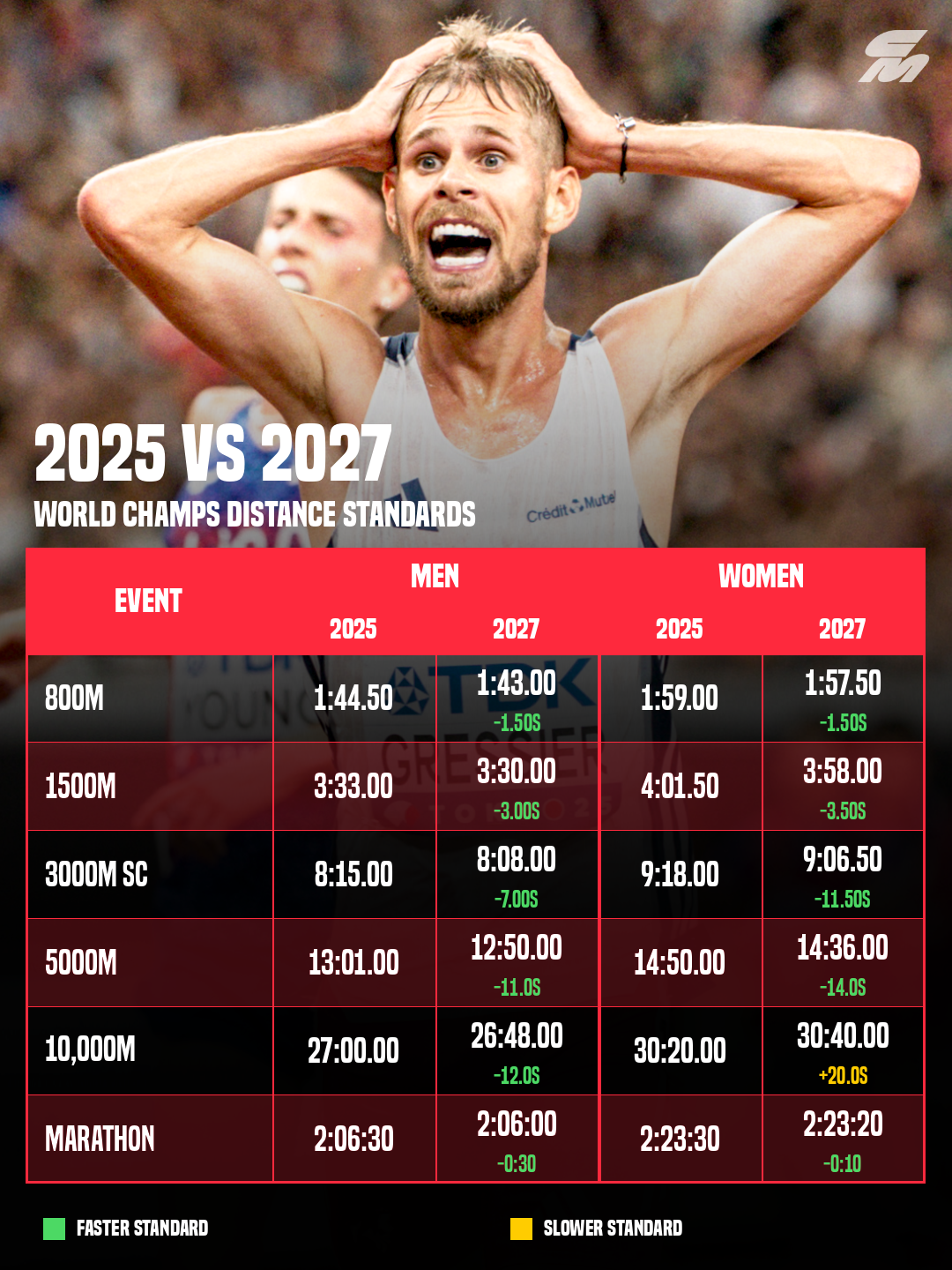
World Athletics has acknowledged the issues in how they’ve set the women’s standards. For example, 13 women ran the new 5000m standard of 14:36 on the track last year, and 10 ran the 10,000m standard of 30:40 (limiting it to three per country). In the men’s steeple, essentially everyone at last year’s world championships hit the standard. In the women’s steeple, Gabbi Jennings ran 9:06.61—just barely missing the new 9:06.5 cutoff—and then the next qualifier after the top six or seven was Marwa Bouzayani of Tunisia with a 9:01.46. There’s a five-second gap in the middle. The depth just isn’t there the same way it is on the men’s side, and that likely influenced World Athletics’ decision making.
Qualifying Standards: The Twist In The Tale
There were a few additional changes that may be a little unexpected, and will greatly shift how athletes schedule out their next year of competition.
For purposes of qualifying standards:
- The marks must be achieved in a Category C event or higher; this broadly means a Diamond League, a Continental Tour Gold, Silver or Bronze meeting, or a National or Area Championships (and for this year, the World Ultimate Championships). For road 5K and 10K, a Category E road race counts.
- Indoor 200m track will not be accepted to qualify for track races. Oversized indoor tracks will still count—so long to BU… time to get acquainted with the Dempsey at the University of Washington!
- Discus marks need to be thrown within the confines of a traditional athletics facility (sorry Throw Town Ramona).
These changes seem to be part of a concerted effort by World Athletics to try and improve the regular season product, and to also reduce instances of athletes benefitting from special conditions—like those found in Ramona and on the indoor Boston University track—to achieve qualifying marks that they may not be able to replicate elsewhere.
The requirement to run qualifying standards at a Category C or higher meet effectively shoots the NCAA system in the foot. Most collegiate meets aren’t on the World Athletics calendar, and even when they are, they’re Category F or D. There are not a lot of Category C meets in the United States. This is potentially going to force American athletes to the European circuit.
To get bronze-level status, a meet needs a minimum level of prize money and a certain number of events. In the US, the dollar amount required isn’t enormous from an American perspective. If people want to create Category C meets or convert existing ones, it’s possible. But you also have to meet some of the other structural requirements World Athletics has in place event diversity and meet structure. In other parts of the world outside of Europe, the availability of Category C meets may be more of an issue, particularly with the funding of the prize money and other requirements.
The other issue is that getting into higher-category meets is deeply political. There’s no qualifying system. It’s often who does your coach know? Who does your agent know? Is your sponsor the meet sponsor? There’s no rule that says a meet has to let you in because you meet a certain criteria.
Sometimes you see a Diamond League start list and you think: what is that athlete doing there when someone who needs the race is sitting at home? Often it’s because the agent manages one big star athlete at the meet and has said they’ll send said star if you also let this up-and-coming athlete in.
Right now it’s so subjective and political that it can be genuinely unfair to athletes who don’t have the right connections.
R.I.P. Boston University’s Indoor Track
The change in the rules to prevent the use of most indoor times to qualify is clearly aimed at Boston University’s magic track where the likes of Grant Fisher, Cole Hocker, and Jimmy Gressier went to achieve their 5000m qualifying standard for the Tokyo World Championships in 2025.
There are essentially no quality 5000m races in the U.S. indoor season outside of BU. The athletes who can run 12:50 on the fabled Boston track can probably do it on the Diamond League too. The athletes that BU really served were those on the margin—the people who ran 12:49 at BU but might run 12:55 outdoors. That’s maybe three or four athletes in the world. And the key point: indoor performances still count toward world rankings. So the calculus becomes: why go to BU for a fast time with no prize money and no placing points when you could go to a higher-category outdoor meet, run a few seconds slower, and earn more points overall?
One slight loophole is that oversized indoor tracks still count for purposes of running qualifying standards. Will we see athletes flocking to the Dempsey over at the University of Washington to use their oversized track to try and run qualifying standards during the indoor season?
Goodbye Throw Town Ramona
The inability to throw a qualifying standard in Ramona removes a major opportunity for an event group that already is among the worst compensated in the sport. Having to travel to Europe to try to throw a qualifying standard at a meet that fits the new requirements might prove prohibitively expensive for some.
But the counter-argument: of the five American men who exceeded the new standard of 67.20 meters last year, only one did it at a certified non-Ramona facility. If you can’t throw the standard outside of Ramona, are you realistically in contention for a medal at Worlds? Probably not.
In addition, marks from Ramona still count for world rankings, so throwing further in Ramona could be one way to boost your ranking and push for qualification, so it perhaps doesn’t mean that Ramona is entirely dead.
In general, in the throws and horizontal jumps, athletes get so many more opportunities to compete. You can throw discus two days after your previous competition, six attempts per meet, 40 to 60 attempts over a season. The world rankings in throws are genuinely reflective of ability in a way that it isn’t always for running events.
How Tough Are The New Qualifying Standards Really?
We have taken a look at how many athletes (when limited to three per country) would have achieved the 2027 entry standards in 2024 and 2025.
Notes:
- The following analysis is based on performances in the calendar year rather than the qualifying period for the Olympics or the Tokyo World Championships.
- For the discus this includes marks from Ramona. In 2025 16 men who threw over 67.20 did so outside of Ramona.
- For the 10,000m and 5000m this does not include times achieved on the roads
- It isn’t possible to analyse the Race Walks as the new distances were not really contested in 2024 and 2025

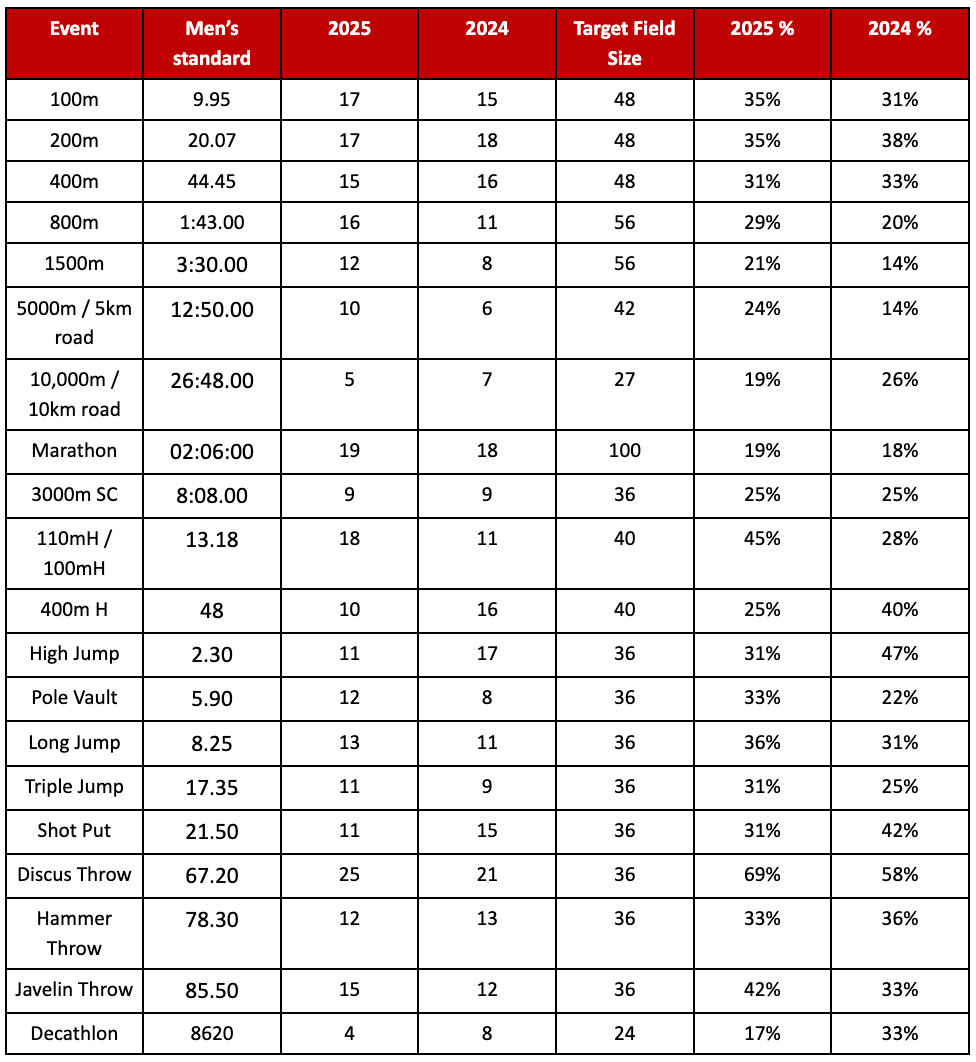

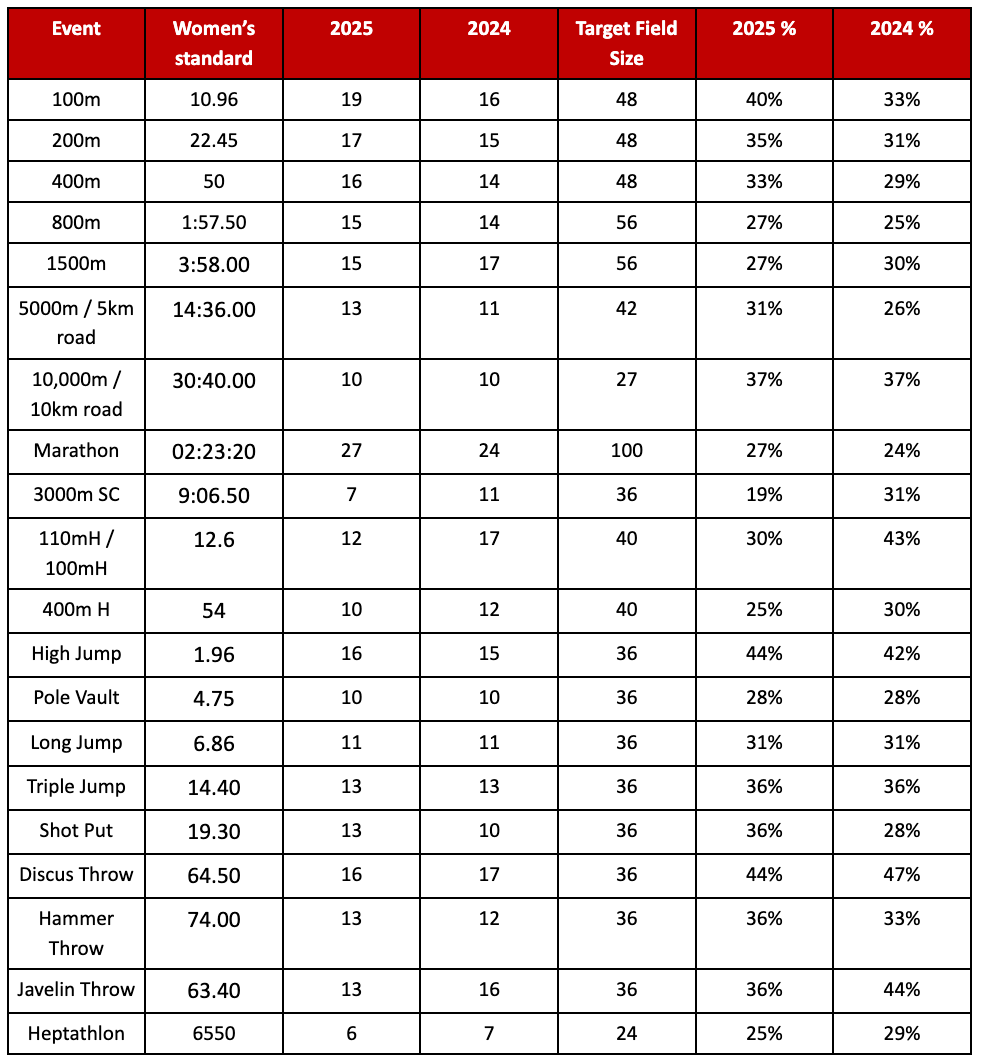
In the men’s 800: 11 people hit the standard in 2024, 16 in 2025—against a field size of 56. In the men’s 1500: 8 people ran sub-3:30 in 2024, 12 in 2025. That’s nowhere close to the 40% target, but World Athletics knows that one fast Diamond League race can immediately put 10 people under the standard (see the crazy fast 3000m in Shanghai/Keqiao where 14 athletes dipped under 7:30 in a single race).
What WA is trying to say is: “it’s going to be really hard to hit the qualifying standard—the very top athletes will still do it, and everyone else has to build a world ranking.”
World Rankings
The key thing to remember is that world rankings require five performances in most events (all track events 1500m and below), and are made up of a “performance score” based on the mark achieved, and a “placing score” based on the category of the meet and position the athlete achieves in the competition. Higher category meets deliver greater placing points which can boost world ranking relative to achieving a similar or sometimes better mark at a lower category meet.
Remember: performances achieved indoors, in Ramona, or at lower category meets will still count for world rankings purposes, even though they will not count for purposes of achieving the qualifying standard.
The Impact On The U.S. Championships
There will probably be even more moments at the U.S. Championships where people turn to an overworked Chris Chavez, plugging away at the rankings calculator. In most field and distance events, there are likely to be fewer athletes with the standard, so it’s just more likely that top three finishers won’t all have it. That means poring over in-flux rankings to see if they can actually make it to Beijing.
In the sprints however, you generally have to have already run the standard to be fast enough to snag a top-three spot at the U.S. Championships. For this event group, it’s definitely less of a concern, even for collegiate sprinters who may not have otherwise achieved the standard at a high enough ranking meet
In the distance events, we would expect U.S. athletes who are realistically vying for spots on the team but aren’t confident they’ll hit the standard to plan out their 2026 and 2027 seasons to optimize their world rankings.
However, the people these rule changes really disadvantage are the surprise finishers: collegians or unheralded underdogs who make the top three at USAs. We’ve seen this before and recently with the likes of Parker Wolfe, Ethan Strand, Dan Michalski, and James Corrigan. These athletes had to chase the standard in the days after the championship. Now, if you’re not already ranked in a meaningful position, it’s going to be incredibly difficult to pull off. A college athlete running conference, regionals, and NCAAs—all championship races without rabbits or wave lights, none of them high-category meets—is not going to have a strong world ranking. Those fairy tale stories just got a lot harder to pull off.
Had these rules applied to 2025, if Cooper Lutkenhaus had run one second slower in his 800 and not gone 1:42-something, he would not have gone to Worlds. He’d been in high school meets all year, worth nothing for world rankings. He would have had to find a sub-1:43 race in the days after the U.S. champs. Under this system, that story is essentially gone.
Marathon Qualifying
As well as entry via the qualifying standard or the world rankings there are two additional routes to qualifying for the World Championships Marathon:
- The top 5 finishers at each Platinum Label Marathons (there are currently fourteen of these—the seven Abott World Marathon Majors plus Amsterdam, Valencia, Seoul, Shanghai, and the Nagoya and Osaka Women’s marathons).
- The winners of the gold label marathons held in Spring 2027 (of which there are currently 11, including Barcelona, Houston, Doha, and Rotterdam)
The generous field size of 100 should mean that there are decent opportunities to qualify on ranking, particularly as many top marathoners across a range of countries may choose to skip out on World Championships in favour of a more lucrative appearance at a fall marathon elsewhere. But picking the right races and having a good day will be critical, especially when there are a limited number of marathons an athlete can race in the 18 month qualifying window. The marathon ranking does include half marathons and 25/30k races, so you can always use a fast shorter race to boost your ranking.
Keep up with all things track and field by following us across Instagram, X, Threads, and YouTube. Catch the latest episodes of the CITIUS MAG Podcast on Spotify and Apple Podcasts. For more, subscribe to The Lap Count and CITIUS MAG Newsletter for the top running news delivered straight to your inbox.

Citius Mag Staff