By Kyle Merber
May 27, 2026
The year was 2022 and the World Championships were in Eugene.
On day three of competition, the world leader in the 110m Hurdles, Devon Allen, was controversially disqualified from the final for having too good of a reaction time. His first movement came 0.099 seconds after the start of the race—the somewhat arbitrarily established human limit of reaction is apparently 0.1 seconds—and he was not allowed to advance on protest.
Hayward Field—old or new—is hallowed ground for American athletes. For the rest of the world, especially with a shiny new facility, there’s no culturally imprinted notion of it being special. Now, however, it was the international track and field community’s turn to come experience the magic for themselves.
On day seven, Shericka Jackson threatened FloJo’s world record running 21.45 to win the 200m. Maybe the Willamette Valley was a sprinter’s paradise after all, and not just a micropolitan area where distance runners can enjoy some low-humidity racing late into the summer?
On the penultimate day of competition, Tobi Amusan set an African record of 12.40 in the 100m Hurdles.
It was a small personal best by one-hundredth of a second and the fastest time of the day, though not enough for the 25-year-old from Nigeria to be considered the favorite… yet. Although she had an NCAA, Diamond League, and Commonwealth Games title to her name and finished one spot off the podium a year earlier at the Olympics, despite these accolades, Amusan wasn’t broadly talked about as a clear cut podium finisher.
On the last day of racing, Amusan stunned the stadium, dropping a 12.12 win in the semi-final to break Keni Harrison’s world record of 12.20, seemingly out of nowhere. The wind reading registered +0.9 m/s, well below the legal limit of +2.0.
Behind Amusan, across both semis, there were an additional five national records and 12 personal bests.
Was the clock broken? Was the track mismarked? Did they forget a hurdle?
While fans were actively still processing what they had just witnessed, and while the rumors and speculation began swirling, it was time for the finals.
And when Tobi Amusan crossed the finish line even faster than in the previous race, the rationalizations over how such a thing could be even possible were kicked up another notch.
Her world championship winning time of 12.06 remains unfathomable to many, even with the assistance of a +2.5 m/s that ultimately made the time not record-eligible.
Sprint races are not like distance events where athletes can call their shot well in advance, tuck in behind a pacer, and if appropriately fit, deliver. In sprints, there are too many factors that need to go perfectly right. And especially in a rhythm race like in the hurdles, seasons can change in the flip of a switch as steps can suddenly fall into place. What should have been a triumphant moment for all fans and pundits of the sport drew skepticism from those outside Africa.
There’s undoubtedly a Western bias in athletics journalism, and that was amplified by the then recent high-profile doping violation of Blessing Okagbare. Additionally, under the classification as a Category A nation, Nigeria was required to test its athletes three times in out-of-competition, unannounced tests. The federation’s failure to properly test 10 of its athletes prior to the 2021 Olympics, resulting in those athletes ineligibility for the Games.
However, Tobi Amusan had never failed a test and all her personal testing protocol had been met. But because of the country she competed for and because she improved so much, she was unfairly criticized and never properly celebrated by the global community.
The best time to really acknowledge how special Amusan’s string of races in Eugene was, was in 2022… in Eugene. The next best time is now. Her performance at Worlds is becoming more validated and accepted each season.
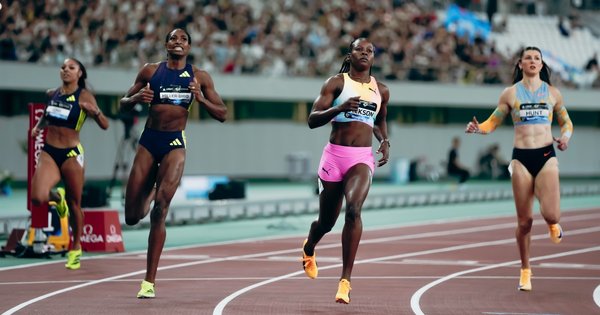
This past weekend at the Xiamen Diamond League, the Olympic champion Masai Russell broke her own American record to run 12.14 (+0.5) and claim the second fastest time in history. This was her third time under that previous world record of 12.20, a mark that has also since been eclipsed by Tia Jones. Similar to Tigst Assefa’s old world record in the marathon, the public perspective shifts once a performance is not as significant of an outlier.
Masai Russell looks poised to continue challenging 12.12 through the rest of this season. And second to Russell in China was none other than Amusan herself, who has already proven she can run faster, and appears to be rounding back into form. As the marks fill in and more eyes are opened, it is important to reexamine the treatment of the current world record holder. The victims of doping in sport are not limited to those who are beaten, but also to those who will unjustly be accused in the future.
(Here is this newsletter’s reaction to that race from 2022: “As the old saying goes, you’re only as good as your second best time—so she did it again. Less than two hours later, Amusan ran 12.06 to win the World Championships. Although the wind read a non-record legal +2.5 m/s, it certainly validated her hours-old world record run.”)

Kyle Merber
Kyle Merber is a former professional miler turned media multi-hyphenate. While he’s not above dropping a quick “back in my day,” he’s far more focused on the present. Since 2021, he has brought his signature analysis and commentary to track fans across the CITIUS MAG network. When he’s not writing The Lap Count or hopping on podcasts, Kyle manages partnerships and pitches a relentless stream of ideas for Chris to consider. He might not be running a 3:52 mile anymore, but he keeps himself in just good enough shape to ensure the athletes still respect him.